Does Dolly Parton Support Any of Her Family
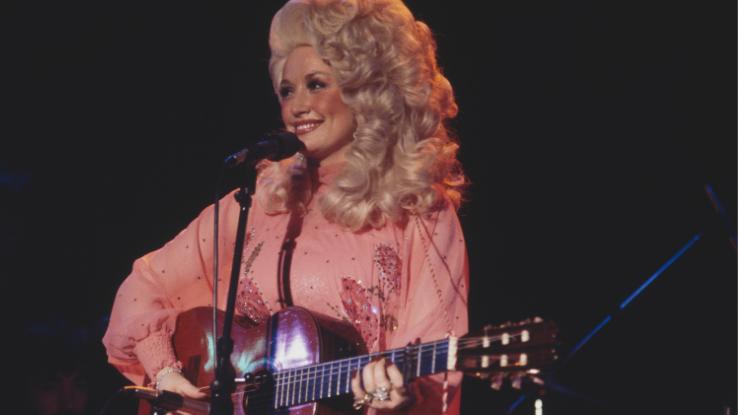
Few things bring folks together similar the music of Dolly Parton. At first glance, her concert-going fanbase may seem to exist equanimous of people who'd otherwise not socialize with each other. The country singer not only resonates with church-going folks, just has a massive fanbase in the LGBTQ+ community as well, peculiarly among drag queens. Of course, these communities aren't monoliths, nor are they mutually exclusive. Still, Dolly leads by example, bringing folks together to celebrate the universal — and the universally felt.
And, perchance, she's the perfect person to do then, since Dolly herself seems to be full of contradictions. At the very to the lowest degree, that'southward part of Radiolab'southward Jad Abumrad'southward thesis on the country star'southward cultural legacy, something the host examines in his WNYC podcast, Dolly Parton'due south America. I of those contradictions? The way pop civilization — and society as a whole — perceives Dolly. On one paw, she'southward a musical genius. In an interview with NPR, Abumrad noted that, "Some of the greatest songs in pop music, they're falling out of her head… She may have written 'I Will Always Dearest You' and 'Jolene' on the aforementioned night."
At the same time, popular culture has made her into a kind of caricature — ofttimes through jokes about her (self-described) flamboyant appearance. This second perception has followed her since the early stages of her career: Dolly, a blond, folksy singer from the S, besides had to debate with being i of the few women in Nashville to hit information technology big in the '60s and '70s. Regardless of the labels or appearances she wanted to — or did — claim, folks were going to have their own entrenched perceptions to foist upon her.
Not That Kind of Feminist
In reference to Dolly'due south post-first album big pause on The Porter Wagoner Testify, Abumrad said that she was "sort of a decorative aspect of the male person prove…and so she perhaps had to [play] the male person game for awhile… [But, as she would say, that's] what made her comfortable. Information technology's just how she wanted to look." All of this is to say that, while she couldn't exactly wrangle the sorts of ingrained notions and stereotypes that bubbled up around her, Dolly, through her confidence, kindness and vibrancy, has e'er felt in control of her career, of herself.
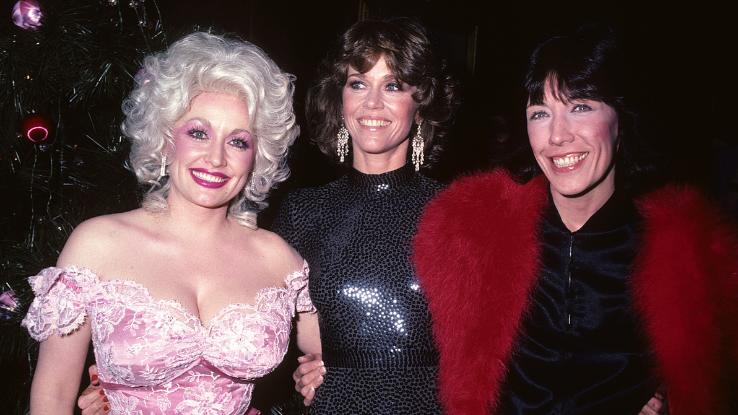
Although she's said, "I've always thought of myself equally bizarre, not equally a sex symbol," she's certainly however seen as a sex symbol past many fans. Similarly, fans experience bolstered past her pro-women lyrics in tunes similar "9 to 5" and "Dumb Blond," but, in the aforementioned way she rejects the sexual activity symbol characterization, Dolly doesn't desire folks to call her a feminist — and she would never cocky-identify as such.
Over the years, Dolly has made it articulate that she's for equal pay and women's rights, that she's "proud" of her "huge gay following" and that she's faced discrimination on the basis of beingness a woman. Nevertheless, on Dolly Parton's America, the legendary vocalist distances herself from the term "feminist," citing that she writes songs most men as show that she doesn't autumn cleanly into that column.
Merely she's spoken out about rejecting the characterization before. "I must be [a feminist] if beingness a feminist means I'm all for women… Only I don't experience I have to march, hold upwards a sign or label myself. I think the mode I take conducted my life and my business and myself speaks for itself. I don't think of it as being feminist." Sometimes this stance she's taken is explained by fans and onlookers alike equally existence the production of a deft businessperson who has thought about how the word "feminist" is so charged — then capable of alienating certain segments of her audience.
"She's so deeply apolitical, at least in what she says," Abumrad said in an interview with NPR. And, yeah, this witting pick — to avoid triggering words merely lead through action — may play into information technology, but in that location'due south more context that we should empathize and acknowledge.
In October 2019, Twitter user Rachel (@harl0tt) wrote an incredible, discerning thread after listening to Dolly Parton's America, tweeting, "I am not shocked or angry Dolly vehemently rejects feminism. Hither's why." Several tweets in length, Rachel's thread explains the context in which Dolly Parton experienced feminism every bit it was back in the '60s and '70s — the means the label became tainted for decades by the second-wave elements that A) equated feminism with hating men, and B) left out a huge swath of the woman-identified population.
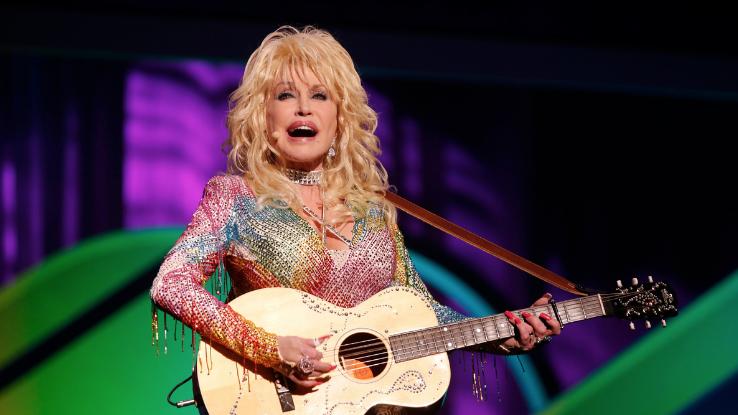
Rachel tweeted, "Dolly Parton has no patience for feminism because of how feminists treated her. [To them] she was a makeup-wearing bimbo [who] objectified her ain body. She doesn't know [feminist theorist and poet Hélène] Cixous. She has no 'serious' contributions to feminist discourse or corporate takeovers. …Classism is rampant in 3rd-wave feminism. It was worse in 2nd-wave, when Dolly faced ridicule" for her looks, for where she came from.
Privileged women — largely college-educated, wealthy and white — excluded Dolly's generation of poor women from their version of feminism. With that in mind, it'due south no wonder Dolly would distance herself from the label. Rachel brings up writer Sarah Smarsh — who frequently discusses socioeconomic course and politics — and paraphrases Smarsh, tweeting, "The part of us that gets mad when clearly feminist women say they aren't feminists is the part of usa that got to go to higher. The function of united states of america that's privileged enough to conjecture."
Meanwhile, Dolly is using her privilege and career to advocate for those who don't accept a platform — and she's creating inclusive spaces at her shows. On that point, Abumrad notes that although her fans from all walks of life aren't exactly engaging in political discussions, "they're in the same place, and they're [being] deeply polite in her presence. That feels like something to me." All of this is to say, it's essential that feminism — "the theory of the political, economic and social equality of the sexes" — includes more than but those privileged enough to theorize.
Source: https://www.ask.com/entertainment/dolly-parton-feminism?utm_content=params%3Ao%3D740004%26ad%3DdirN%26qo%3DserpIndex
0 Response to "Does Dolly Parton Support Any of Her Family"
Post a Comment