based on the resolution, summarize the story’s message about what it means to be a hero.

Assyrian Forums
Greetings · Shläma · Bärev Dzez · Säludos · Grüße · Shälom · Χαιρετισμοί · Приветствия · 问候 · Bonjour · 挨拶 · تبریکات · Selamlar · अभिवादन · Groete · التّحيّات

A New Little Essay

Archived: Read only Previous Topic Next Topic
Home Forums Peshitta Topic #453
Help Impress Share
Andrew Gabriel Roth

Send email to Andrew Gabriel Roth Send private message to Andrew Gabriel Roth View profile of Andrew Gabriel Roth Add Andrew Gabriel Roth to your contact list

Member: Sep-half dozen-2000
Posts: 384
Member Feedback

A New Piffling Essay

May-07-2001 at 01:53 AM (UTC+iii Nineveh, Assyria)


Shlama all--


Here'southward a rough draft of an idea that kept bouncing around in my head today and would not stop until I had brought information technology into the earth. I have all the citations for everything I have written about, but I did not include them in this draft. Still, if anyone is interested, both Paul and I have all this data.

Bask and have a bang-up day!


Fleshing Out the Historical Argument for Aramaic NT Primacy
By Andrew Gabriel Roth

In the great contend near determining the original language of the New Attestation, bang-up accent has been given—and rightfully so—to the linguistic proofs axiomatic in the Peshitta. All the same, what is sometimes defective is a clearer understanding of known historical processes that dovetail with the linguistic argument. In fact, despite all the intricacies that sometimes bungle the mind of a sincere seeker on this topic, the fact is much headway tin be made in resolving the issues by answering two unproblematic questions:

1) Exercise you have that the New Testament books were written by the people and in the manner that the Bible describes?

2) Do you view the testimony of the very primeval Church Fathers, as recorded primarily by Eusebius, every bit generally reliable?

In regards to the first question, I believe the linguistic side of the argument to be sufficiently stiff as to be able to withstand even the most fervent attacks that radical secularist scholars tin can perhaps throw at this issue. However, since linguistics is not our focus, I will say that anyone who accepts the traditional authorship of the 22 books in the Peshitta Canon is well-nigh in a position of having to accept the Aramaic primacist position as well.

I say this primarily considering of what we know of these authors in terms of when they lived and died. By the twelvemonth 67, for example, we know that Matthew, Mark, Peter, Paul, James the Just, and Jude were all expressionless. Luke, while living significantly by this time, nevertheless links his writings to Paul’s time, which leaves only John to have composed anything after the year 70. Withal, fifty-fifty John wrote no later than the yr 96, which puts every single piece of NT literature within seven decades of the crucifixion.

So, if virtually all the writers of NT were first century Jews, and well-nigh wrote from State of israel to other Aramaic speaking Jewish believers in the Messiah that populated the Heart East, it seems certain that Aramaic mss from the Apostles would take circulated to those aforementioned audiences. Now, if some members of the synagogue spoke Greek, there was already a well established tradition in place that they could attend Hebrew/Aramaic services and get them translated into their colloquial on the spot. This was certainly the example of Cornelius, whose faithfulness is recorded in Acts ten. Similarly, Hebrew Scriptures themselves were frequently sent to distant synagogues both in and out of State of israel and translated into Aramaic â€Å"targums” by the local authorities. Either mode, a native Aramaic speaker like Paul or Peter could reasonably await that an Aramaic letter they wrote—for that was their native language—could exist properly translated locally into the vernacular by leaders of that individual associates. Therefore, the language that the congregation spoke is irrelevant.

With those issues out of the way, now allow us deal with the 2nd question. Information technology is a known historical fact that 95% of all ancient mss have perished. The Hebrew mss of the NT were, for instance, by and large kept in Jerusalem where the fighting of two Jewish revolts likely took their toll. In both cases, Rome hunted downward and destroyed as many Hebrew books as they could find. Josephus records more than 180,000 people dead in the streets of the urban center when the Temple burned, and as many equally 100,000 more than may have been killed in Galilee. Similar numbers also apply due south, by the Expressionless Body of water area of Masada, and anywhere else where rebellion reared its head. Similarly, during the Bar Kochba Revolt (132-135 CE), 500 synagogues, each with 300 students, were put to the sword and destroyed IN ONE Metropolis ALONE, WITH THE NATIONAL FIGURES Fifty-fifty WORSE. Finally, in either case, information technology seems unlikely that the Romans would intendance if the Hebrew mss were from the Old or New Testaments, they burned people live in those scrolls with equal delight.

Therefore, in many cases we see through the glass lens darkly, and gaps are inevitable. Scholars frequently recognize this pitfall with secular works. Homer, if he lived at all, wrote the Iliad at least 500 years earlier the Trojan War was known to have happened and is considered basically reliable. And Julius Caesar’s account of the Gallic Wars, with simply iii known mss a whopping 1200 years removed from the consequence, is accepted as genuine without batting an eyelash. Given that degree of latitude, mayhap then we can too accept the writings of Eusebius who, while writing his masterpiece on ecclesiastical history, is only 250 years from the primeval events he records. Eusebius also had access to original source documents (now of course since lost) that he no doubtfulness would have been forced to produce had someone caught him in a grievous mistake. It is certainly the case also that Eusebius knew his contemporaries who hated Christianity would have seized on any opportunity to discredit such a work, and therefore give him another incentive to get these details right.

Therefore, while none of these facts gives Eusebius an absolute armor of perfection on every infinitesimal point, information technology would seem that, taken all together, to certainly put any brunt of proof on Eusebius’ accusers to establish that a major mistake had been made. On that score, from his time to our own, this has never been done. Then, if we tin can expect at 250 years as the very small window for error that it clearly is and combine information technology with Eusebius’ own fourth dimension tested and excellent reputation, then we can reliably move forward with a compelling case for Aramaic NT primacy from a historical perspective.

Finally, one more thought before proceeding: Any credibility assigned to Eusebius should too be extended to all the other sources that I accept used here, considering Eusebius is a kind of â€Å"worst case scenario”. All the other sources used here are either more ancient than the venerable historian or else they are describing things that are contemporaneous with their own times in the tertiary and 4th centuries. This as well applies to both Roman Catholic and Eastern Assyrian/Syrian Church building Fathers. With those thoughts in mind, please consider the post-obit:

1) As I said at the commencement, the New Testament itself bears powerful historical testimony from the time of the crucifixion to about the yr 96, when John the Apostle died on the island of Patmos. All NT books are therefore conspicuously composed during the first century. The question is, of course, in which language was this washed?

2) Enter once again our hero, because Eusebius tells us of a human being named Papias (ca. seventy-130 CE) who studied with the apostle John for several years. Noting the use of the phrase â€Å"young man” (as opposed to â€Å"child”) and combining this fact with when we know the apostle came to this identify and when he died, the only conceivable time frame that fits for him to tutor Papias is betwixt the years 90 and 96. Papias then wrote that he knew that Matthew had written (ta logia) down the sayings of the Messiah IN THE HEBREW Linguistic communication, and that everyone â€Å"translated as best every bit they could”. Therefore, prior to the close of the get-go century, no disquisitional Greek edition of Matthew existed. Also, since eastern and western tradition is unanimous that Matthew was the first Gospel written and John the last, it becomes extremely significant that 1 of the apostle’s own students tells us this fact. The earliest known fragment from whatever part of the NT is from John’s Gospel-- and it is dated to the year 125! This fact, of course, leaves us with a very tight window for all these Gospels to come into the Greek language and puts the Aramaic originals clearly back into the first century!

three) Also, just effectually the time of Papias’ decease, we know ii other critical events happened:

a) Yehuda, the 15th and last Nazarene Nasi (leader) of the Run across of Jerusalem, stepped down and was replaced with a Gentile â€Å"bishop”. Yehuda, like his fourteen predecessors get-go with James the Just (led from 30-62 CE), was a native Aramaic speaker who venerated but Hebrew and Aramaic scriptures. Since there was not a single commencement century Jewish teacher in Israel that even remotely acknowledged the Septuagint Greek OT as viable, allow lonely sacred, there tin can exist niggling doubt of the language of choice for any scriptures and liturgy that these Nazarene leaders would accept employed.

b) Evidence for these precise Hebrew/Aramaic Scriptures and liturgies is also plant in the historical record. Eusebius records that another early Church leader, Hegisippius, may have been born in Israel and led an assembly of Jewish believers in ane of the nearby cities known to exist part of the famous â€Å"Decapolis”. While most of the people who lived in this area were Greek, the Decapolis’ proximity to Israel forced Hegisippius into a virtually peculiar duty. Eusebius writes that Hegisippius: â€Å"alterum in Syri interpratione sermonis”, or to put information technology another way, â€Å"interpreted Syrian sermons”, obviously into the Greek language spoken by his followers. If there were Aramaic â€Å"sermons”, it seems a virtual certainty that they would then, every bit they do today, reflect teachings of Aramaic Scripture. What Eusebius is then describing is, once again, the aboriginal Jewish practice of â€Å"targumming”, which was done for the do good of both Aramaic and Greek speakers who wished to sympathize Hebrew Scripture improve. Since Hebrew and Aramaic are besides very closely related languages every bit well, the conclusion that a Semitic original of some role of the New Attestation was translated into Greek for a local audience has found a clear historical precedent. Also, we know that Hegisippius did this service some time earlier his first arrival in Rome, which is clearly dated to the yr 130.

4) And then, simply xx years subsequently, a heretic named Tatian attempted to combine the four Gospels into one narrative for use in his Syrian congregation. This work, the Diatesssaron, was began by Tatian’s mentor Justin Martyr in about the yr 150, and Tatian himself died in the yr 172. While no copy of this piece of work survives, no serious scholar questions its existence every bit information technology is well attested to and quoted by other ancient government. We also know that an Aramaic edition, whether translated or originally composed in that language, was definitely done by Tatian. Certainly the same Gospels used by Hegisippius and so would have been familiar to Tatian, whether he stuck to them in his own version or not.

five) Next we come to some other prominent leader mentioned past Eusebius: Origen (ca. 170-230 CE). In this case, what nosotros have is a critical quotation of Origen from Hebrews ii:ix-ten, with one disquisitional departure: It never appears in a single Greek mss! In fact, the only place that Origen’south version of Hebrews 2:ix-10 does appear is in the original Peshitta NT. Furthermore, by virtue of this association, we know two other vital facts. Starting time, Origen had to accept written this quotation downwards prior to his death in the year 230. And second, since Hebrews is the last book of the eastern canon, we know the complete Peshitta NT must have circulated extensively enough prior to this time to be found in Rome, where Origen put or had translated that quote into Greek. In either example, this complete Peshitta NT canon was done more than than 100 years before either the Cureton / Sometime Syriac mss were produced, equally well as before the Westward itself had settled all the issues of its own Greek canon in the fourth century.

half-dozen) From this time forward and then, tracing the origins of the Peshitta becomes even easier. Various contemporaries of Eusebius, most notably Epiphanus (Panarion 29-xxx), make mention that the Nazarenes in the fourth century had an original Hebrew copy of Matthew. Another claim regarding the same document is besides recorded by Eusebius and may date centuries earlier than that. Co-ordinate to that account, a human being named Pantaeus traveled to Republic of india during the early on part of the 2d century and visited with the Saint Thomas Church, who had the manuscript. Nonetheless, the Saint Thomas Church also has documents that talk of their FIRST CENTURY migration into India, when they would accept presumably taken their Hebrew/Aramaic Scriptures from State of israel with them to their new domicile.

7) As a outcome of all this evidence, the claims of the Assyrian Church of the East that the New Testament was written originally in Aramaic past the Apostles and handed down intact and without any revisions must be given great weight when combined with other parts of the historical record. And finally, the fact that every early on Aramaic Christian group venerated the Peshitta even every bit they warred with ane another too tin non be overestimated in this calculation.

Print Top

  • RE: A New Little Essay , KeithL, May-09-2001 at 11:41 PM, (1)
    • A fortune?, Paul Younanmoderator , May-ten-2001 at 09:23 AM, (2)
      • RE: A fortune?, KeithL, May-10-2001 at 00:19 AM, (3)
    • RE: A New Footling Essay , Andrew Gabriel Roth, May-xi-2001 at 00:49 AM, (4)
      • RE: A New Little Essay , Samuel, May-eleven-2001 at 09:25 AM, (5)
        • RE: A New Picayune Essay , Andrew Gabriel Roth, May-eleven-2001 at 03:42 PM, (seven)
        • RE: A New Little Essay , MSMD, May-30-2001 at 09:51 PM, (8)
        • RE: A New Trivial Essay , Dean Dana, May-30-2001 at 10:17 PM, (ix)
          • RE: A New Footling Essay , Paul Younanmoderator , May-xxx-2001 at 11:17 PM, (10)
      • Sure!, Paul Younanmoderator , May-11-2001 at eleven:06 AM, (6)
        • RE: Sure!, Biga, Sep-05-2001 at 12:05 PM, (xi)
          • RE: Sure!, Paul Younanmoderator , Sep-06-2001 at 07:24 PM, (12)
            • RE: Sure!, Biga, Sep-07-2001 at 08:38 AM, (13)
              • RE: Certain!, Paul Younanmoderator , Sep-07-2001 at 03:30 PM, (fourteen)

Forums Topics Previous Topic Next Topic

KeithL

Send email to KeithL Send private message to KeithL Add KeithL to your contact list

Member:
Member Feedback

1. RE: A New Little Essay

May-09-2001 at 11:41 PM (UTC+three Nineveh, Assyria)

In reply to bulletin #0

  Andrew,
What is your definition of "lilliputian"? Tome might be more similar it. First-class synopsis of your view. I would like the citations (since I have a copy of Eusebius' Ecclesiastical History).
How do you answer critics like Bivin and Blizzard who maitain that when Eusebius says Hebrew he ways Hebrew and not Aramaic?
Could you go into more item equally to the significance of Hebrews ii:9-10?
By the way since I accept found this site I have spent a fortune on books. I just bought Dr. Kiraz's 4 volumes of "Comparative Edition of the Syriac Gospels" and am looking forward to getting them in.
Keith

Print Acme

Paul Younan


Paul Younanmoderator

Send email to Paul Younan Send private message to Paul Younan View profile of Paul Younan Add Paul Younan to your contact list

Member: Jun-1-2000
Posts: one,306
Member Feedback

ii. A fortune?

May-10-2001 at 09:23 AM (UTC+three Nineveh, Assyria)

In answer to message #1

  Akhi Keith,

Don't you mean an inheritance? That sells for most $i,000!

I experience bad, didn't mean to be so controversial equally to brand people spend that much money, but I'm sure it volition be very useful to you.


Fk^rwbw 0ml4

Peshitta.org

Print Elevation
KeithL

Send email to KeithL Send private message to KeithL Add KeithL to your contact list

Member:
Member Feedback

3. RE: A fortune?

May-10-2001 at 00:nineteen AM (UTC+three Nineveh, Assyria)

In reply to bulletin #2

  How-do-you-do Paul,
Don't repent, I dear this site. I'm now 99% convinced of Aramaic primacy. You have been a tremendous approval (also as Andrew). I am thoroughly enjoying this site and your comments.
Keith

Print Top
Andrew Gabriel Roth

Send email to Andrew Gabriel Roth Send private message to Andrew Gabriel Roth View profile of Andrew Gabriel Roth Add Andrew Gabriel Roth to your contact list

Member: Sep-6-2000
Posts: 384
Member Feedback

iv. RE: A New Little Essay

May-11-2001 at 00:49 AM (UTC+iii Nineveh, Assyria)

In answer to message #i

  Hi Akhi Keith!

Why not start past looking up these verses:


Hist. Eccl., iv,22

Hist. Eccl., 111, xxxix, 16), Papias said that Matthew nerveless (sunetaxato; or, according to two manuscripts, sunegraphato, composed) ta logia (the oracles or maxims of Y’shua) in the Hebrew (Aramaic) linguistic communication, and that each one translated them as best he could

Hist. Eccl., III, xxiv
Hist. Eccl., four, 22

There are many others, merely these were what I could get for you right away. I listing, of course ALL OF THEM in my volume.

As for Bivin Blizzard, I don't put much stock in it at all. We accept to retrieve 2 critical facts that BnB seems to ignore or forget altogether.

one)The interdependence of Hebrew and Aramaic.

two) The relative level of Hebrew/Aramaic expertise of the Church fathers.

With regards to point #1, we have to seaprate SCRIPTS from DIALECTS or LANGUAGES. You may have, for example, heard of the Aramaic Scriptures Research Society in Israel, who has put out a very schoarly piece of work. On the left page is the original Aramaic Peshitta, and on the right a Hebrew translation. But-- and here is the kicker-- BOTH ARE IN HEBREW SCRIPT! Permit that sink in a bit and recall about this. Parts of Tenakh (in Daniel and Esther)are Aramaic words in Hebrew messages, and the aforementioned can be said for the Talmud. In fact, at that place are many of my people who do not even realize that what they are thinking of as Hebrew (Kaddish, Kol Nidre) are actually Aramaic works "dressed up" In Hebrew letters. So there are scripts and at that place are languages and they are frequently ii different things. The fact that Hebrew and Aramaic share and then many things in common also and that Aramaic is ofttimes sprinkled throughout what is believed to exist thoroughly Hebrew literature does not help matters.

Now for indicate two. Does anyone out there actually think that Eusebius and others were not but fluent in both Hebrew and Aramaic but able to actually tell the departure betwixt what is written in Hebrew and what are just Hebrew messages representing Aramaic words WHICH ARE ALMOST IDENTICAL IN SO MANY CASES? I call back not. So if Eusebius referes to Hebrew but it's actually Aramaic, that'south fine, and if he means Hebrew and information technology is Hebrew, great!

On the other hand, let the states say they could and Hebrew is as Hebrew does (Forrest Gump School). In that case, the shared vocabulary, morphology and sentence structure make that state of affairs as indistinguishable in 95% of what consititutes the Aramaic primacist position. That is why Hebrew primacy is just fine by me...but I merely know that for certain that the Aramaic line of what must surely have been Hebrew mss as well from the first century has survived. Simply that does not hateful I am hostile to Dr. Trimm'due south opinion on the importance of some of these other later Hebrew witnesses. I love them all.

Hope this helps and thanks for the not bad question. I would like Paul to deal with the Hebrews quote, if he does not listen.

Shlama west'burkate
Andrew Gabriel Roth

Print Meridian
Samuel

Send email to Samuel Send private message to Samuel Add Samuel to your contact list

Member:
Fellow member Feedback

5. RE: A New Little Essay

May-11-2001 at 09:25 AM (UTC+iii Nineveh, Assyria)

In reply to message #4

  Akhi Andrew:
We should be reminded that the Syriac Greek word for Syrian Aramaic is similar to the Judaic Aramaic , merely in that location are some later Greek influences present that are less present in the Judaic dialects beingness Yerusalmi and Baboli(Babylonian). The Judaic Aramaic uses the Hebrew adopted alphabet of Foursquare Aramaic adopted from Babylon in the fifth century before Messaih. Also the Judaic form differed from the lingua franca of the Babylonians and later the Persians in that it adopted a number of Hebrew words into an Aramaic form. The Peshitta uses an Estrangela script developed in the first century of Messiah. Information technology also shgows Greek Church influence in linguistic communication and traslation , non nowadays in the Anceint Aramaic of the Persian Empire and although some Greek and Latin is nowadays in the Hebrew Mishnah circa 170A.D. and also in the Aramaic of the Talmud the types due differ concsiderablly. If the Aramaic ofd the Peshitta is actually the same every bit that of Messiah Yeshua, then why did it originate in North Eastern Syrian arab republic out side of Israel among a non Jewish gentile people of colonies of the left over Aschmonid or Perssian Empire. Is it not possable that this non Israeli from of literary Aramaic was adopted by these people from the Greek influence to translate the Helenistic literture that is the Septuagaint compared withthe hebrew Old Attestation and the Greek New Testament for a people who could not comprehend either Hebrew or Greek. You lot take the word for Torah which is Hebrew is translated into Greek equally Nomos, or Nomosa in Aramaic of the Peshitta, no Judaic source would use the word Nomos, when the Hebrew word Torah would practice. too annotation the age of the oldest Peshittta are all centuries latter than the Greek New Testament Texts which become dorsum to 130A.D. in John's Gospel fragment and the complete Gospels to 200A.D. The oldest Greek New Attestation the Sinaticus which is complete is dated as 330A.D. The oldest Peshitta new Attestation is dated circa fifth -6 stentury A.D. around 100-200 years later. In fact there is no mention of the Peshitta Erstwhile or New Testaments earlier the fourth century. At that place are older Syrian Aramaioc texts, but they to are showing a strong Church building Greek influence. Not to mention that the Syrian Orthodox Church and near of COE agree that while the Peshitta is held as sacred information technology is the work of a fourth century Greek translation to fill a serious need in the trunk of Messiah. Yes some do disagree similar the wishfull thinking of Victor Alexander, DoctorGeorge lamsa who not only state the New Attestation original is the Peshitta but even decline the Onetime Testament hebrew in favor of the Aramaic Peshitta. The late religious leader held a simmilar view in COE that is the belatedly Mar Shimun. I hateful no disrespect , just I can not hold with the position opf a few individuals over the majority eviedences prrove other wise, specially the challange that the original Torah was writen in Aramaic non hebrew and surrives in the Peshitta solitary. Shlama W'Berkhata, Sam

Print Top
Andrew Gabriel Roth

Send email to Andrew Gabriel Roth Send private message to Andrew Gabriel Roth View profile of Andrew Gabriel Roth Add Andrew Gabriel Roth to your contact list

Member: Sep-6-2000
Posts: 384
Member Feedback

vii. RE: A New Little Essay

May-xi-2001 at 03:42 PM (UTC+3 Nineveh, Assyria)

In reply to bulletin #5

  >Akhi Andrew:
>We should exist reminded that the
>Syriac Greek word for Syrian
>Aramaic is similar to the
>Judaic Aramaic , but there
>are some later Greek influences
>present that are less present
>in the Judaic dialects being
>Yerusalmi and Baboli(Babylonian). The Judaic
>Aramaic uses the Hebrew adopted
>alphabet of Square Aramaic adopted
>from Babylon in the fifth
>century before Messaih. Also the
>Judaic form differed from the
>lingua franca of the Babylonians
>and later the Persians in
>that information technology adopted a number
>of Hebrew words into an
>Aramaic form.

How-do-you-do Akhi Shmuel! I am aware of the dialectical differences. My point is that if Eusebius in the 4th century saw either a Hebrew certificate or an Aramaic in Hebrew letters, he would probably not know the difference.


The Peshitta uses
>an Estrangela script developed in
>the first century of Messiah.
>It likewise shgows Greek Church building
>influence in language and traslation
>, not present in the
>Anceint Aramaic of the Farsi
>Empire and although some Greek
>and Latin is present in
>the Hebrew Mishnah circa 170A.D.

Yes the earliest estrangela script is dated to six CE in Edessa (Turkey). Simply again I am talking about dialect and Not scripts. At that place is in fact every indication that shorthand NT mss may have been originally washed in HEBREW or HEBREW Like script. I am addressing instead the upshot of dialect, and hither I disagree with you. The dialect of the Peshitta is very consistent with the Galiliean Aramaic spoken in the first century, if not identical.

>and also in the Aramaic
>of the Talmud the types
>due differ concsiderablly. If
>the Aramaic ofd the Peshitta
>is really the same every bit
>that of Messiah Yeshua, then
>why did information technology originate in
>North Eastern Syria out side
>of State of israel amongst a non
>Jewish gentile people of colonies
>of the left over Aschmonid
>or Perssian Empire.

Remember here Akhi Shmuel that Galilee is where the northern kingdom used to exist, and that the Assyrians poopulated it with their own people subsequently destroying Israel in 722 BCE. The hybrid of Assyrians and Jews in that expanse later became known as Samaritans, and it is therefore no suprise that these influences likewise prove up in the dialect of the Jews there besides.

Is it
>not possable that this not
>Israeli from of literary Aramaic
>was adopted past these people
>from the Greek influence to
>translate the Helenistic literture that
>is the Septuagaint compared withthe
>hebrew Old Testament and the
>Greek New Testament for a
>people who could not comprehend
>either Hebrew or Greek. Y'all
>take the word for Torah
>which is Hebrew is translated
>into Greek as Nomos

"nomos" is not necessarily a Greek word. It may in fact be an Aramaic loan give-and-take "namosa". Nevertheless looking into that though beefore I will be certain.
, or
>Nomosa in Aramaic of the
>Peshitta, no Judaic source would
>use the word Nomos, when
>the Hebrew word Torah would
>do.

Don't exist too sure. I believe Peshitta Tenakh, which was done by Jews in Babylon, does use information technology. They certainly use ORAYTA, the Aramaic give-and-take for "covenant" which is non used in the Hebrew Tenakh to the all-time of my knowledge.

too note the historic period
>of the oldest Peshittta are
>all centuries latter than the
>Greek New Testament Texts which
>go back to 130A.D. in
>John'southward Gospel fragment and the
>complete Gospels to 200A.D. The
>oldest Greek New Testament the
>Sinaticus which is consummate is
>dated as 330A.D. The oldest
>Peshitta new Testament is dated
>circa 5th -half-dozen stentury A.D.
>around 100-200 years subsequently.

You'll simply have to read my book about this. Oldest fragment of John is 125 CE. Oldest codices (full NT books) either in Aramaic or Greek is fourth-fifth centuries. Fragments don't betoken primacy-- linguistic analysis does, and there is plenty of that evidence to exist had here.
In
>fact there is no mention
>of the Peshitta Quondam or
>New Testaments before the fourth
>century. There are older Syrian
>Aramaioc texts, but they to
>are showing a potent Church
>Greek influence.

Where is your source? I totally disagree. The liturgy of these earliest churches proves this wrong utterly. See Paul about this. It is the Greek mss that show an Aramaic influence, not the other way around. Otherwise, we will accept to go point for signal and line by line.

Not to mention
>that the Syrian Orthodox Church
>and most of COE agree
>that while the Peshitta is
>held as sacred it is
>the work of a quaternary
>century Greek translation to fill up
>a serious need in the
>torso of Messiah.

WRONG! George Kiraz, who is in the SOC may agree with this. But no ancient Aramaic Church has this position. Your information is flawed, no offense intended. In fact, all aboriginal Aramaic Churches (including St. Thomas Christians in India who we accept records of a second century Hebrew Matthew "as information technology was originally written") proclaim the text has come down from first century apostles without revision.

Yes some
>do disagree like the wishfull
>thinking of Victor Alexander, Dr.George
>lamsa who not simply state
>the New Testament original is
>the Peshitta but even turn down
>the Sometime Testament hebrew in
>favor of the Aramaic Peshitta.
>The tardily religious leader held
>a simmilar view in COE
>that is the late Mar
>Shimun. I mean no boldness
>, but I can not
>hold with the position opf
>a few individuals over the
>majority eviedences prrove other
>wise, especially the challange that
>the original Torah was writen
>in Aramaic not hebrew and
>surrives in the Peshitta alone.

That's why we are here Shmuel. To hash out this evidence. The majority has been wrong earlier, you know. My inquiry of the concluding 10 years is not, I assure you, wishful thinking. 95% of all NT scholars are non competent in the original language of the Messiah, and they exercise not even know the deviation between Peshitta and Peshitto. How then can you trust them to render an opinion on the affair? If all they know is Greek, then all they will see is Greek patterns in Greek mss.

>Shlama W'Berkhata, Sam

And peace to yous too. Remember, how can it be shown that the original linguistic communication of an world leader resulted in an oral layer in that language being transmitted into compositional grade in the linguistic communication of their enemies, only to come dorsum into the original linguistic communication half a millennia subsequently? Do you lot know how long the Aramaic mss were unknown in the Due west and therefore is it any surprise that traditions sprung upwards discounting them? It would seem to me that having an oral layer skip written form in its native language to get into another has never been demonstrated anywhere else in the world. Therefore, I believe the burden of proof is on them to evidence it did happen, not me to say information technology did not.

Shlama w'burkate (and Shabbat Shalom)

Andrew Gabriel Roth

Print Tiptop
MSMD

Send email to MSMD Send private message to MSMD Add MSMD to your contact list

Member:
Member Feedback

viii. RE: A New Little Essay

May-thirty-2001 at 09:51 PM (UTC+3 Nineveh, Assyria)

In reply to bulletin #5

  I AM NEW TO THIS SITE, Take STUDIED FOR A FEW YEARS AND Past SELF REFLECTION Have Niggling KNOWLEDGE OF THE FACTS AS YA ALL DO. I AM READING THIS SITE WITH VIGOR, STUDYING GREEK, ARAMAIC AND AM ABSOLUTELY FASCINATED WITH THIS HX.
SOME THINGS (PHILOSIPHICALLY AND FACTS) Come TO MIND AS I READ.
1)FEW THINGS IN LIFE ARE Absolute.
2)IF MY Knowledge IS Correct THE APOSTLES OF ESHOO WERE GIVEN TONGUES, And then THEREFORE COULD SPREAD THE Word TO ALL IN MANY LANGUAGES. It WAS Likewise Mutual FOR PEOPLE OF THIS ERA TO Be CONVERSIVE IN HEBREW/ARAMAIC AND LATIN OR GREEK, ESPECIALLY THE MERCHANTS FOR Trade PURPOSES.
3)"More WILL BE REVEALED" AS STASTICALLY THE GENESIS BIBLE CODE HAS SHOWN. THE Dead SEA SCROOLS Take SHED SOME KNEW LIGHT. ARCHEOLOGY IS REVEALING NEW EVIDENCE OF THE BIBLICAL PAST."SO MUCH HAS BEEN LOST". OUR Task Beingness, PUTTING TOGETHER WHAT'Southward LEFT OVER AND TO Exist FOUND By IN THE MOST TRUTHFUL,ENLIGHTNING Fashion HUMANLLY POSSIBLE.
THE NT ARGUMENTS PRESENTED SEEM TO BE Accented, ONE OR THE OTHER, GREEK OR ARAMAIC.......
THE ? ARISES AND Equally I BELIEVE THE TRUTH Volition SET You Complimentary WHICH I SEEK FERVERENTLY:
WHY NOT SOME COMBINATION OF EITHER?...WITH SOME LATIN AND HEBREW "ORIGINALS" THROWN IN Likewise,WHICH MAY Exist THE BOTTOM LINE. Information technology'S Similar ,CATHOLIC VS BAPTIST STUFF, THE BOTTOM LINE IS THE WORD, Non THE RELIGION. "SO MUCH HAS BEEN LOST"
THE DIFFERENCES ARE SOMETIMES:
MINOR-(A LARGE OBJECT, WHETHER IT Be CAMEL OR ROPE, FITING THROUGH A Pocket-size Pigsty MAKES THE Aforementioned PHILOSIPHICAL Statement) AND SOMETIMES:
MAJOR- As (RIGHTOUS VS WICKED WHERE THE ARAMAIC ARGUMENT HOLDS STRONG AND ENLIGHTENS THE SCRIPTURE DRAMATICALLY.)
THE Bottom LINE TO ME IS Anything THAT COMES TO Light TO ENLIGHTEN THE SCRIPTURES TRUTH TO HUMANKIND IS WORTH SEEKING, AND I AM Open TO.THAT'S WHY I'M HERE!
YA-ALLS NOTES AND RESEARCH HAS THRILLED ME BEYOND EXPRESSION AND I Thank YOU. I'LL E'er REFER TO THE MESSIAH As ESHOO AND AM PASSING THE WORD OF....HIS REAL Proper noun. GOD Bless.... MS MD

Print Top
Dean Dana

Send email to Dean Dana Send private message to Dean Dana Add Dean Dana to your contact list

Fellow member:
Member Feedback

9. RE: A New Little Essay

May-thirty-2001 at 10:17 PM (UTC+iii Nineveh, Assyria)

In reply to message #5

  >Not to mention
>that the Syrian Orthodox Church
>and most of COE agree
>that while the Peshitta is
>held every bit sacred it is
>the work of a fourth
>century Greek translation to fill
>a serious need in the
>body of Messiah. Aye some
>do disagree like the wishfull
>thinking of Victor Alexander, MdGeorge
>lamsa who not but state
>the New Testament original is
>the Peshitta just even reject
>the Erstwhile Testament hebrew in
>favor of the Aramaic Peshitta.
>The late religious leader held
>a simmilar view in COE
>that is the belatedly Mar
>Shimun. I mean no disrespect
>, merely I can not
>hold with the position opf
>a few individuals over the
>majority eviedences prrove other
>wise, especially the challange that
>the original Torah was writen
>in Aramaic non hebrew and
>surrives in the Peshitta alone.
>Shlama Westward'Berkhata, Sam

Shlama Shmuel,

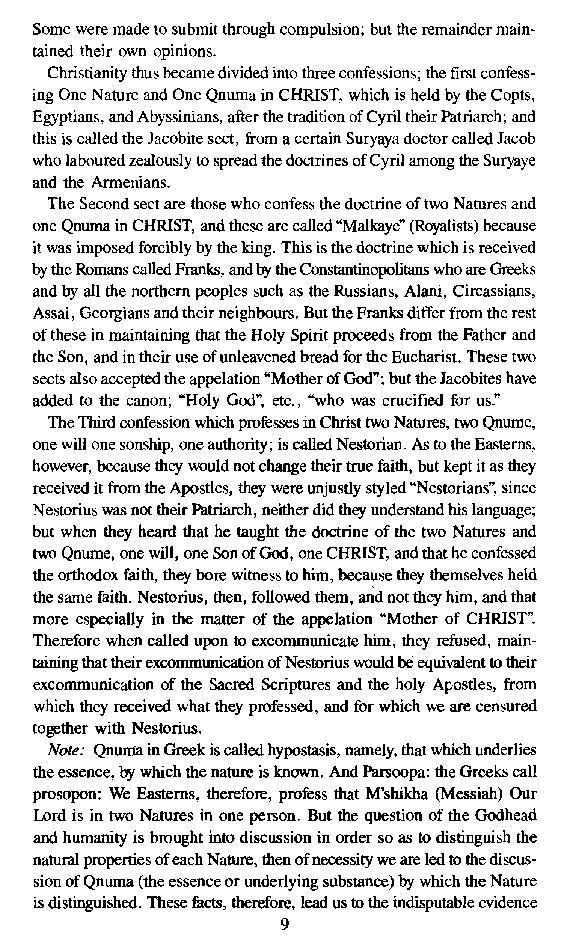
Who in the Church of the East claims that the Peshitta is a fourth century translation from Greek? Did y'all do a survey of "most" COE members?

Akhi Dean

Print Top

Paul Younan


Paul Younanmoderator

Send email to Paul Younan Send private message to Paul Younan View profile of Paul Younan Add Paul Younan to your contact list

Member: Jun-i-2000
Posts: 1,306
Fellow member Feedback

10. RE: A New Fiddling Essay

May-30-2001 at xi:17 PM (UTC+3 Nineveh, Assyria)

In reply to bulletin #9

  Shlama Akhi Myaqra due west'Khabiba Dean!

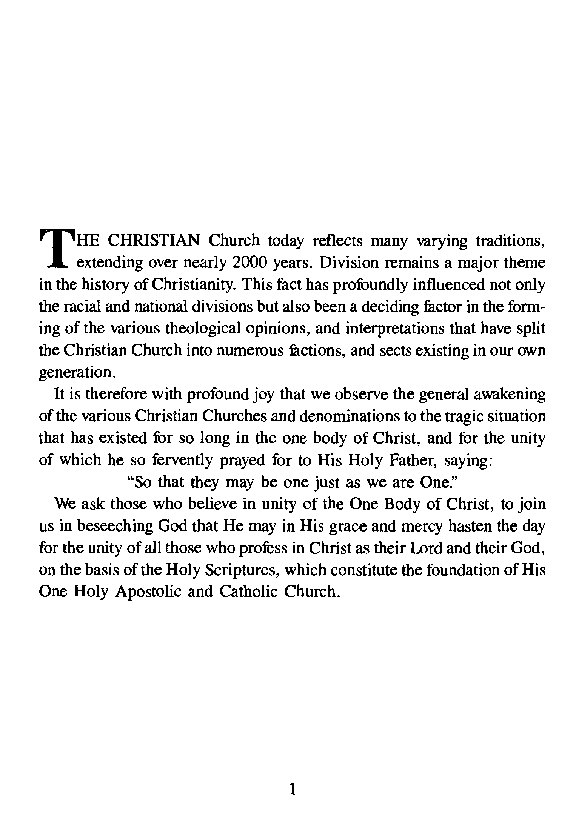
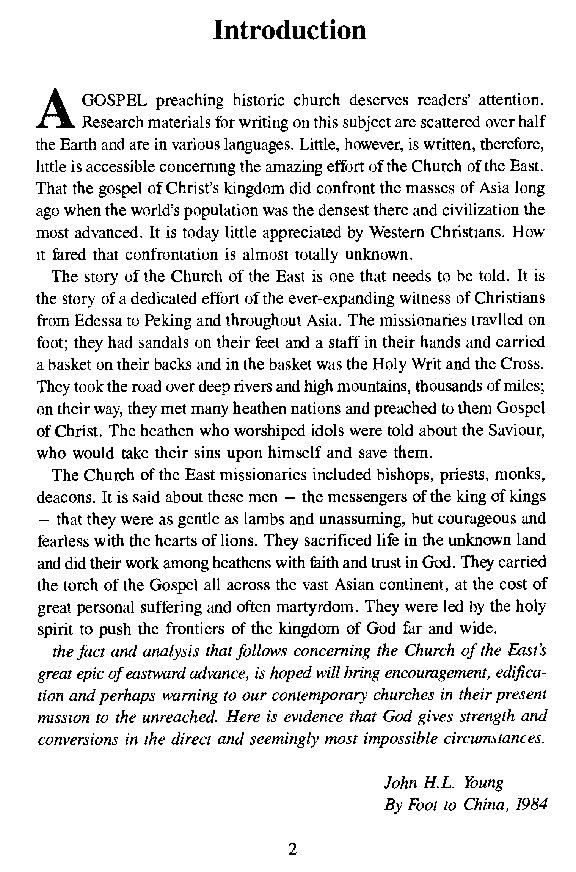
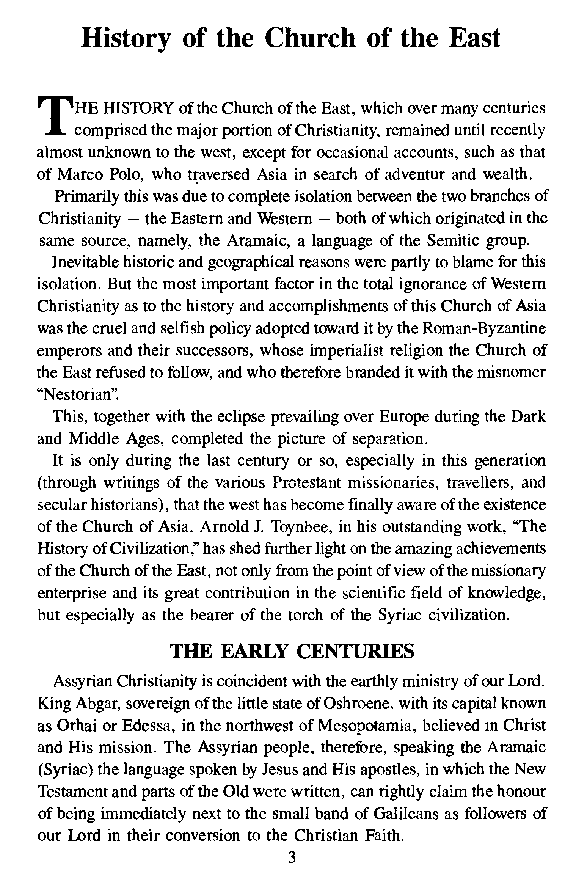
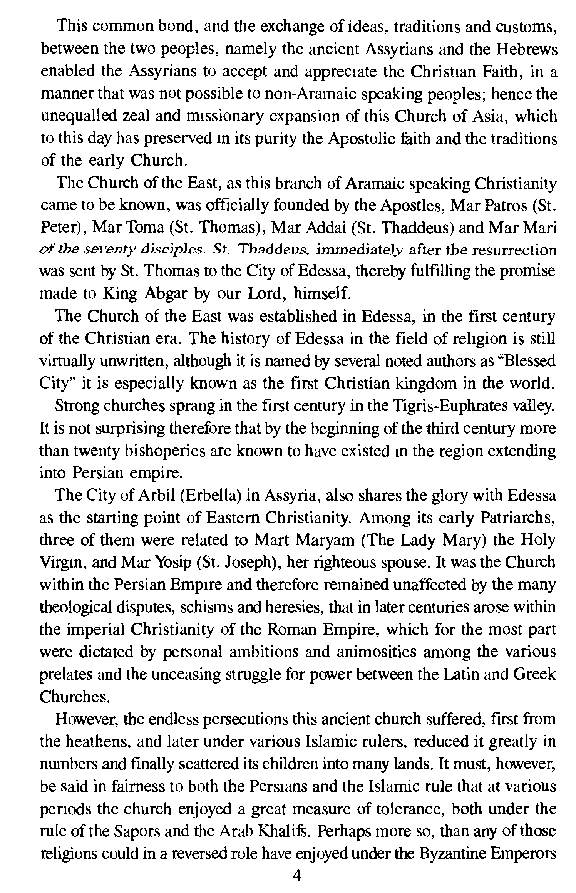
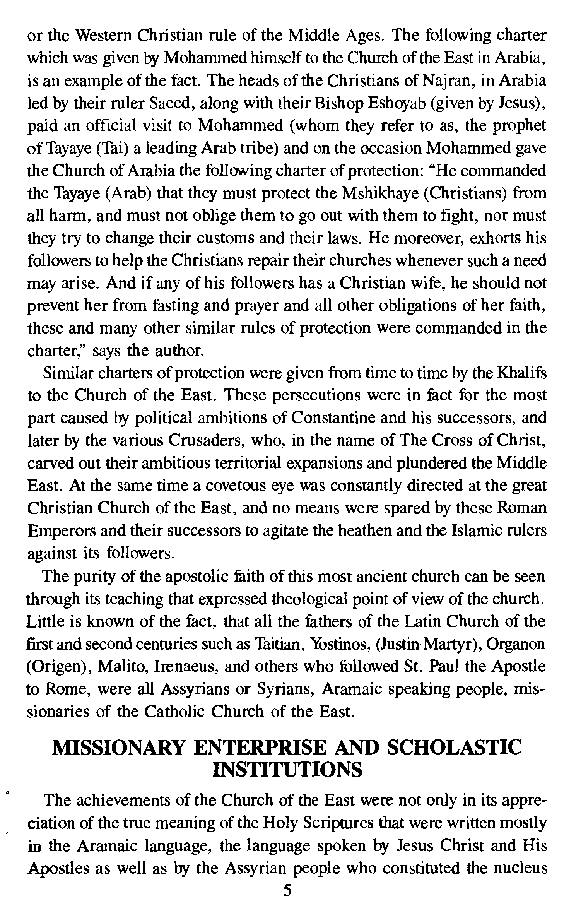
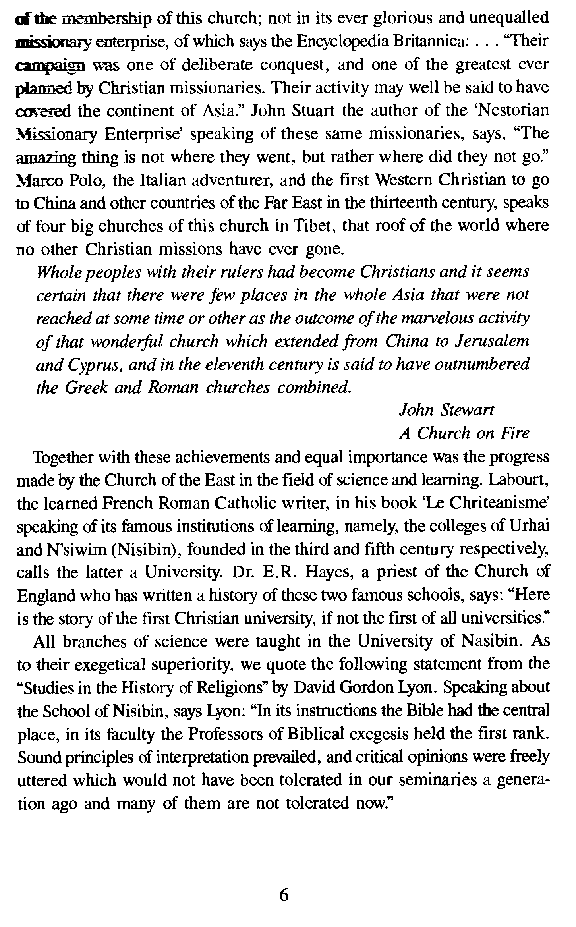
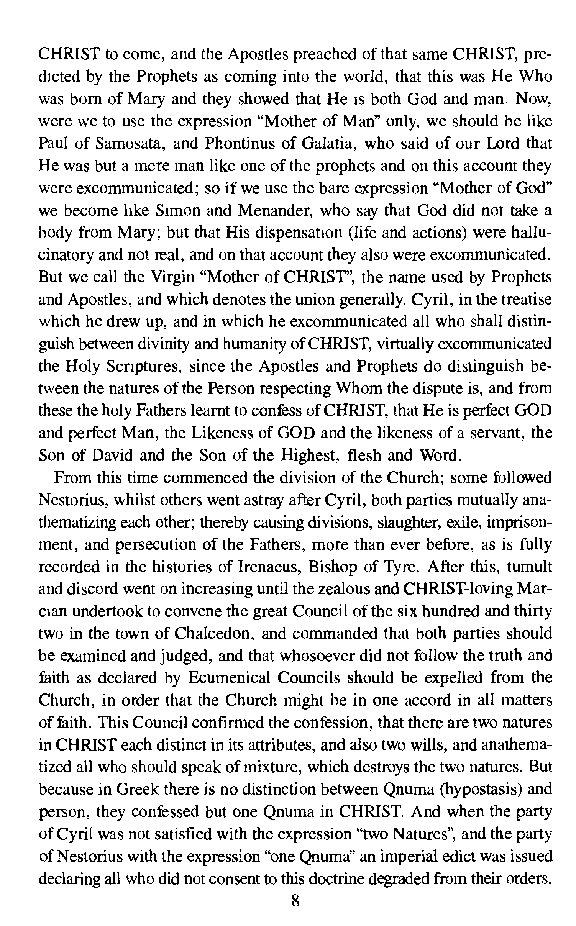
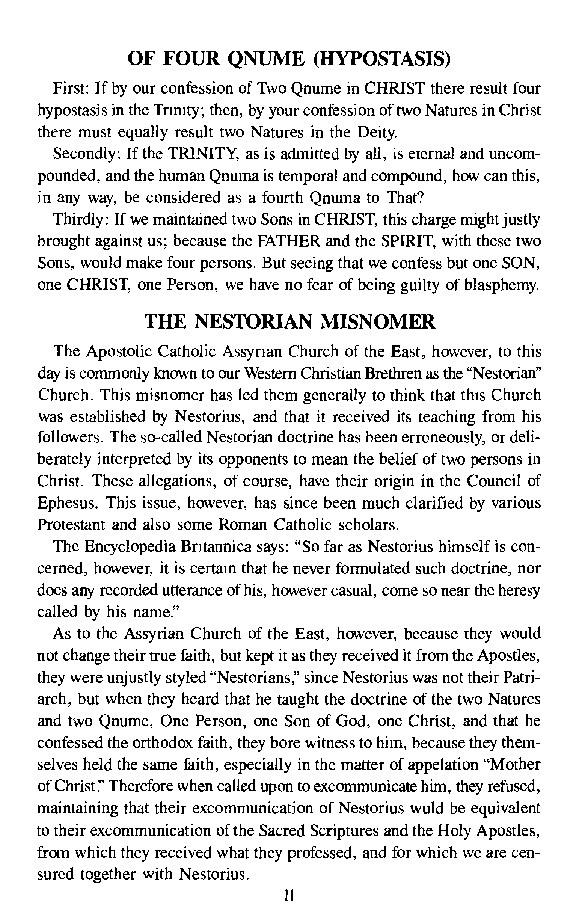
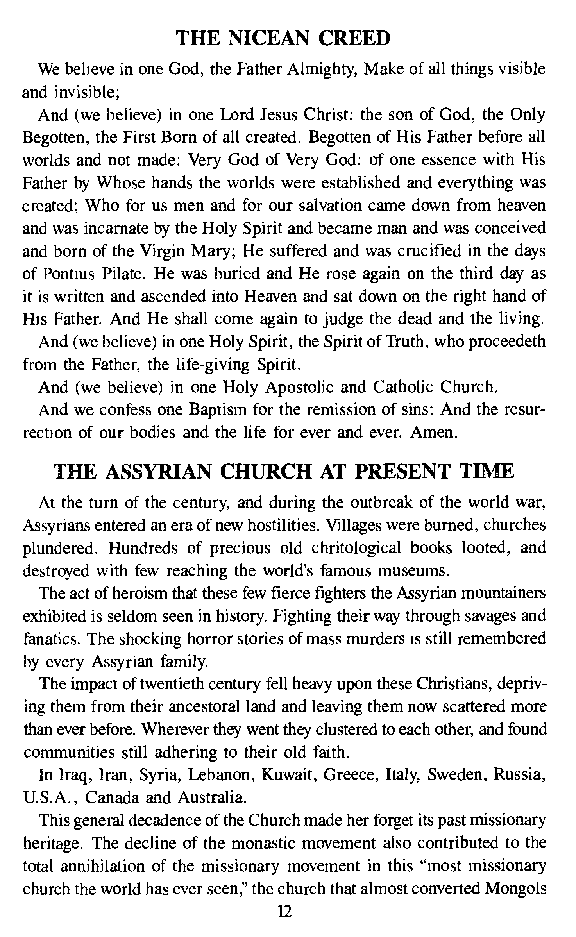
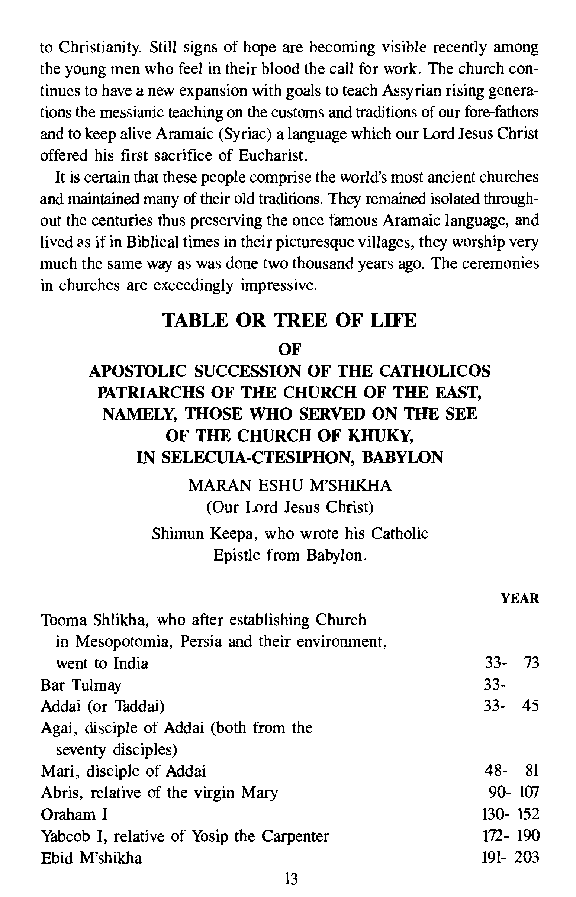
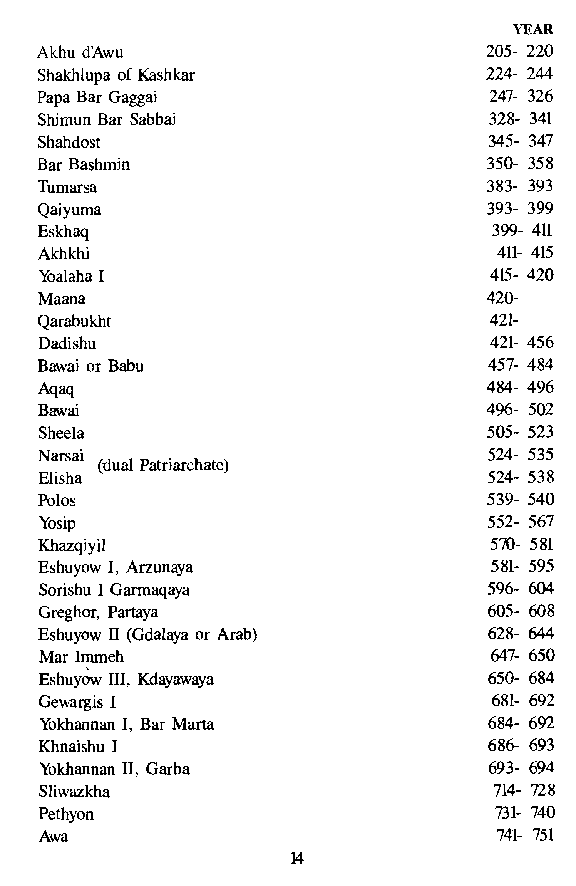
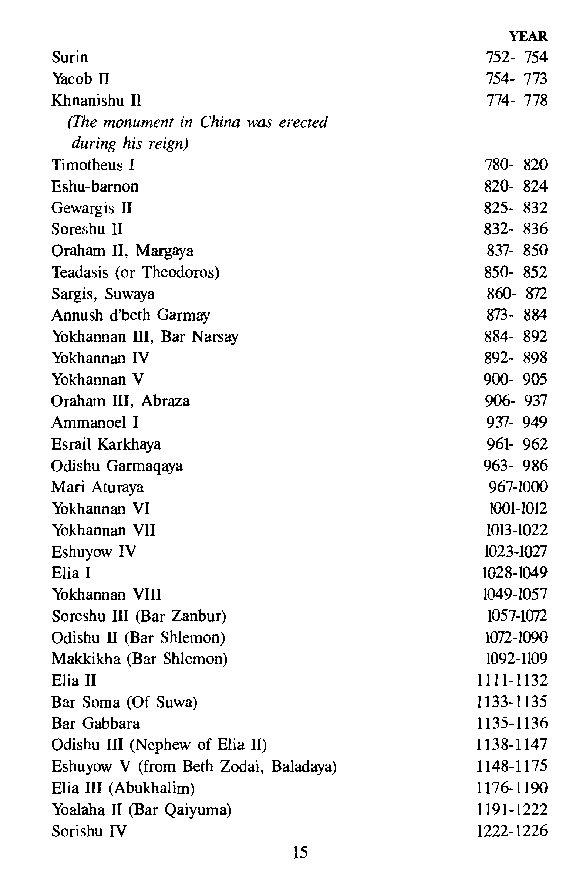
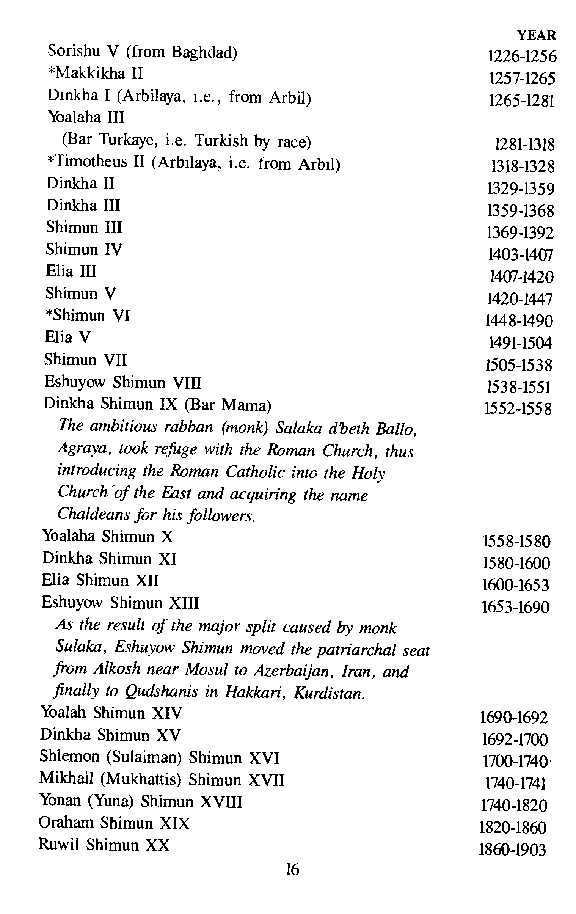
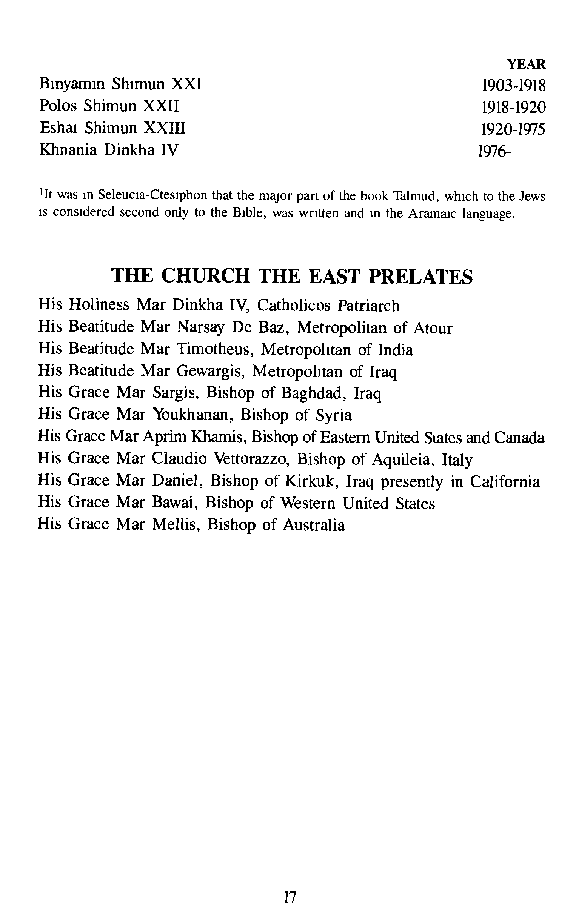
Hither is the "majority view" of the CoE members - thanks to your attempt in scanning the official booklet!


Fk^rwbw 0ml4

Peshitta.org

Impress Top

Paul Younan


Paul Younanmoderator

Send email to Paul Younan Send private message to Paul Younan View profile of Paul Younan Add Paul Younan to your contact list

Fellow member: Jun-i-2000
Posts: i,306
Member Feedback

half-dozen. Sure!

May-xi-2001 at xi:06 AM (UTC+iii Nineveh, Assyria)

In respond to message #4

» Last edited by Paul Younan on May-11-2001 at eleven:09 AM (CT)

Shlama Akhay Andrew & Keith,

The significance of this poesy in the book of Hebrews is HUGE, so I volition take my time explaining it - because I feel this is very important on a number of bug, not only Aramaic primacy.

For starters, let me say that the Peshitta of the Church building of the East (not including the Western "Peshitto" of the Syriac Orthodox Church), is the merely version of the NT which has the following reading in Hebrews 2:9 -

"That He (Maran Eshoa), without God, tasted death for the sake of every person."

The only version that has this reading is the Eastern Peshitta. No Greek manuscript, no Latin, no other Aramaic version. With thousands upon thousands of manuscripts at our disposal, only ONE has this reading.

I will continue this "little essay" with a cursory groundwork on Origen of Alexandria, whose writings volition exist crucial to this argument:

Origen of Alexandria


(From the Catholic Encyclopedia - www.newadvent.org/cathen)

Born in 185, Origen was barely seventeen when a bloody persecution of the Church building of Alexandrian broke out. His male parent Leonides, who admired his precocious genius was charmed with his virtuous life, had given him an fantabulous literary education. When Leonides was cast into prison, Origen would fain accept shared his lot, but existence unable to acquit out his resolution, as his mother had hidden his clothes, he wrote an agog, enthusiastic letter of the alphabet to his male parent exhorting him to persevere courageously. When Leonides had won the martyr's crown and his fortune had been confiscated by the purple regime, the heroic child laboured to support himself, his mother, and his six younger brothers. This he successfully accomplished past becoming a teacher, selling his manuscripts, and past the generous aid of a certain rich lady, who admired his talents. He assumed, of his ain accord, the direction of the catechetical school, on the withdrawal of Cloudless, and in the following year was confirmed in his part by the patriarch Demetrius (Eusebius, "Hist. eccl.", VI, ii; St. Jerome, "De viris illust.", liv). Origen's school, which was frequented past pagans, soon became a plant nursery of neophytes, confessors, and martyrs. Amid the latter were Plutarch, Serenus, Heraclides, Heron, another Serenus, and a female person catechumen, Herais (Eusebius, "Hist. eccl.", Half-dozen, four). He accompanied them to the scene of their victories encouraging them by his exhortations. There is cypher more touching than this picture show Eusebius has drawn of Origen's youth, so studious, disinterested, ascetic and pure, ardent and zealous fifty-fifty to indiscretion (Half dozen, iii and six). Thrust thus at and so early on an historic period into the teacher'due south chair, he recognized the necessity of completing his didactics. Frequenting the philosophic schools, especially that of Ammonius Saccas, he devoted himself to a study of the philosophers, particularly Plato and the Stoics. In this he was but following the case of his predecessors Pantenus and Clement, and of Heracles, who was to succeed him. Afterward, when the latter shared his labours in the catechetical school, he learned Hebrew, and communicated frequently with certain Jews who helped him to solve his difficulties.

Hebrews 2:nine, co-ordinate to Origen


(From Commentary Critical and Explanatory on the Whole Bible, by Jamieson, Fausset and Brown avalaible at - https://bible.crosswalk.com/Commentaries/JamiesonFaussetBrown/jfb.cgi?book=heb&affiliate=2#Heb2_9)

The commentary has this explosive statement:

The reading of ORIGEN, "That He without God" (laying aside His Divinity; or, for every being relieve God: or perhaps alluding to His having been temporarily "forsaken," as the Sin-bearer, by the Father on the cross), is not supported by the manuscripts.

The Verdict

Here are the facts of this example:


  • The Peshitta (and non the Western Peshitto) is the only version of the NT which has this reading.
  • Origen (185-232), a Greek from Alexandria quoted Hebrews 2:9 as found only in the Eastern Peshitta.
  • The Greeks changed their scriptures. Obviously, at the time of Origen the Alexandrian Greek version MUST have had this reading, like-minded with the Peshitta. NO surviving Alexandrian Greek (or, any other Greek) manuscript has this reading.
  • The book of Hebrews is the last volume in the Eastern Canon, which has a dissimilar order than the Western Canon. This is strong testify that the Peshitta existed, equally is and complete, before 185 Advertizement.
  • The Christological controversies which tore the Church apart at Ephesus and Chalcedon are impacted greatly by this discovery. Nestorius is vindicated. The Monophysites changed their scripture - bottom line. The reading did not hold with their theology, and they "modified" it.

The words of our late Patriarch, His Holiness Mar Eshai Shimun, summarize it the best:

"....The Church of the East received the scriptures from the easily of the blessed Apostles themselves in the Aramaic original, the language spoken by our Lord Jesus Christ Himself, and that the Peshitta is the text of the Church of the East which has come up down from the Biblical times without whatever alter or revision."

Fk^rwbw 0ml4

Peshitta.org

Print Top
Biga

Send email to Biga Send private message to Biga View profile of Biga Add Biga to your contact list

Member:
Posts: 193
Member Feedback

11. RE: Sure!

Sep-05-2001 at 12:05 PM (UTC+3 Nineveh, Assyria)

In respond to bulletin #6

  Love Paul,

You lot write that this reading is merely in eastern Pesitta:

"That He (Maran Eshoa), without God, tasted death for the sake of every person."

This suggests that the famous "Eli, Eli lmana sabachtani" ways really that the greek based NTs says i.e. forsaken.
But George Lamsa states that sabachtani stands in commencement person atypical, states that lmana can stand up only in expression not in questions, and think it mean "My God, My God, for this I was kept."

He said forsaken is "nashatani" not "shabachtani".

What is the thruth with this?

Plíz, respond me....

Print Tiptop

Paul Younan


Paul Younanmoderator

Send email to Paul Younan Send private message to Paul Younan View profile of Paul Younan Add Paul Younan to your contact list

Member: Jun-one-2000
Posts: 1,306
Fellow member Feedback

12. RE: Sure!

Sep-06-2001 at 07:24 PM (UTC+3 Nineveh, Assyria)

In reply to message #11

  Shlama Akhi,

If I understand correctly, you lot are wondering what the impact of the eastern Peshitta reading in Hebrews has on the last words of Christ on the cross - perhaps that information technology verifies the Greek reading of 'forsaken.'

I don't run into any relation between the two. In my view of Christology, the humanity and divinity of Christ are carve up, although united in one person.

To me, this reading in Hebrews justifies that Christology - God did non die that twenty-four hours on the Cantankerous, His human nature (distinct from his divine nature) which he took from us did. That'south what makes Him the only perfect sacrifice.

Having said that, I'd like to return to the last words on the cross. I disagree, as does about 100% of the Church of the East, with Lamsa'southward rendering of that verse.

I've nil against the human, and (God remainder his soul) he's not here to defend himself. I have nothing against the man, personally. Just I exercise remember his translation was marred past his ain personal theology - a theology which greatly differed from the Church in which he was baptized, and the Church he mentions then frequently in his writings.

My rendering of the terminal words on the Cross are 'My God, my God, why have you spared me?', in the sense of 'lets go this over with.'

The discussion Shwaqthani (pronounced many unlike ways depending on dialect) tin mean 'left me', merely in this case it is best understood in information technology'due south alternate pregnant - 'spared me.'

Promise this helps.

Fk^rwbw 0ml4

Peshitta.org

Print Top
Biga

Send email to Biga Send private message to Biga View profile of Biga Add Biga to your contact list

Member:
Posts: 193
Member Feedback

13. RE: Sure!

Sep-07-2001 at 08:38 AM (UTC+three Nineveh, Assyria)

In reply to message #12

  Dear Paul,

cheers the reply!

It is bad, I ordered a lot of Lamsa and Rocco books and I idea never that at that place can be so great difference between aramaic translations. If If I found this site sooner ....

I visited your site, Peshitta, it is great! What translations do y'all recommend, I have only the Lamsa's version of Peshitta..

What ways "akhi" ?

Print Pinnacle

Paul Younan


Paul Younanmoderator

Send email to Paul Younan Send private message to Paul Younan View profile of Paul Younan Add Paul Younan to your contact list

Member: Jun-1-2000
Posts: one,306
Member Feedback

14. RE: Certain!

Sep-07-2001 at 03:30 PM (UTC+3 Nineveh, Assyria)

In respond to bulletin #13

  Shlama Akhi Gabor,

"Akhi" ways "my brother" in Aramaic, from the root "Akh" (brother.)

Books by Lamsa and Rocco are great to have in your collection - I have all of them in my personal library. I agree with Lamsa 90% of the fourth dimension, I agree with Rocco 10% of the time.

The most of import thing is to acquire Aramaic, and compare the original Aramaic confronting all translations (the i on this site included.) All translations are imperfect. All human beings are, too. Don't trust me or anyone else.

That's one reason for the Interlinear text on this site. And so you can see the Aramaic for yourself and guess what the proper pregnant should be. Other tools we accept adult here include a Lexicon and, well-nigh importantly, a Concordance. These are extremely useful when studying these things. You can see how a word is used everywhere it occurs.

So to answer your question, I don't recommend any translations. I recommend using the original. The Interlinear on this site will guide yous, and since it has the original Aramaic underneath the English translation, it should be helpful. But once more, e'er verify and study the Aramaic words independently of any translation.

I will translate things differently from Lamsa or Rocco or Ethridge. Other Aramaic speakers will translate differently from me. We are all prone to making mistakes or to non understanding something completely.

Translations are funny like that. That'south why we have hundreds of English versions (and, hundreds of Greek versions.)


Fk^rwbw 0ml4

Peshitta.org

Print Top

Forums Topics Previous Topic Next Topic

Assyria \ã-'sir-é-ä\ n (1998) 1: an ancient empire of Ashur two: a autonomous country in Bet-Nahren, Assyria (northern Iraq, northwestern Iran, southeastern Turkey and eastern Syria .) three: a democratic state that fosters the social and political rights to all of its inhabitants irrespective of their religion, race, or gender 4: a democratic country that believes in the liberty of religion, conscience, linguistic communication, education and culture in faithfulness to the principles of the United Nations Charter — Atour synonym

Ethnicity, Religion, Language
» Israeli, Jewish, Hebrew
» Assyrian, Christian, Aramaic
» Saudi Arabian, Muslim, Standard arabic

Assyrian \ã-'sir-é-an\ adj or n (1998) 1: descendants of the ancient empire of Ashur ii: the Assyrians, although representing but ane single nation as the direct heirs of the ancient Assyrian Empire, are now doctrinally divided, inter sese, into 5 principle ecclesiastically designated religious sects with their corresponding hierarchies and distinct church governments, namely, Church of the East, Chaldean, Maronite, Syriac Orthodox and Syriac Catholic.  These formal divisions had their origin in the 5th century of the Christian Era.  No one can coherently understand the Assyrians as a whole until he can distinguish that which is religion or church from that which is nation -- a matter which is especially hard for the people from the western world to understand; for in the East, by force of circumstances beyond their control, religion has been made, from time immemorial, virtually into a criterion of nationality. iii: the Assyrians accept been referred to as Aramaean, Aramaye, Ashuraya, Ashureen, Ashuri, Ashuroyo, Assyrio-Chaldean, Aturaya, Chaldean, Chaldo, ChaldoAssyrian, ChaldoAssyrio, Jacobite, Kaldany, Kaldu, Kasdu, Malabar, Maronite, Maronaya, Nestorian, Nestornaye, Oromoye, Suraya, Syriac, Syrian, Syriani, Suryoye, Suryoyo and Telkeffee. — Assyrianism verb

Aramaic \ar-é-'máik\ n (1998) 1: a Semitic linguistic communication which became the lingua franca of the Middle East during the ancient Assyrian empire. two: has been referred to as Neo-Aramaic, Neo-Syriac, Classical Syriac, Syriac, Suryoyo, Swadaya and Turoyo.

Delight consider the environs when disposing of this textile — read, reuse, recycle. ♻
AIM | Atour: The State of Assyria | Terms of Service

smallwarad1961.blogspot.com

Source: https://www.atour.com/forums/peshitta/453.html

0 Response to "based on the resolution, summarize the story’s message about what it means to be a hero."

Post a Comment

Iklan Atas Artikel

Iklan Tengah Artikel 1

Iklan Tengah Artikel 2

Iklan Bawah Artikel