Pearson What Makes Pop Art Fundamentally Different From Abstract Expressionism?
Without a doubt, rhythm in art can be considered one of the central principles of art and its production. Interested in exploring more and understanding in depth yet some other of its elements, the repetition in art is quite mayhap one of the about interesting methods that the artists implement to create a certain movement, stillness, design, confusion, to rebel against the notion of tradition, re-define the idea of the original and the copies, or to bandage true focus on one office of the artwork that either makes the piece of work more than visible or purposely invisible. Seen every bit one of the almost important techniques for reduction, repetition is used in an equal amount both in music and visual arts[ane] and is seen equally both aesthetic and poetic device [2].
Why repeat? Exercise repetition artists use the same motifs over and again to achieve perfection or is in that location something more than to repetition art? This and much more nosotros have researched for you, so please read on.
Definition of Repetition in Fine art
Before nosotros return to some of the about memorable pieces of repetition in fine art and turn our focus on its history, nosotros need to take a step back to mention the definition of repetition in the visual product. Seen equally 1 of the fundamentals of creativity, repetition, in a like way to the rhythm, helps to create a sense of movement within an artwork. In visual production, information technology is a recurrence of a item line, pattern, shape, or other visual elements in a single or part of the series[three]. The production of something which is repetitive yet at the same time exciting is a challenge, equally many consider the recurrence every bit slow and withal. The element of repetition in fine art many authors used on purpose to comment on the state of the world around us and to challenge the public to slow downward the race for the achievement of consumerism gods and idols. Sometimes the repetition is used to build a sense of tension if no variations are implemented and it is often in the subtle detail that the fundamental to the understanding of such pieces lies[4].
There is a diversity of ways in which the repetition in fine art can occur. It tin be even or uneven, regular or irregular, it tin course radiation, occurring when the echo of elements is spread out from the central point, or a form of graduation, where the parts slowly become smaller or larger[5]. Working with repeated patterns, and this was highly regarded during the Fine art Nouveau flow and its pattern-making production, the surface of the piece of work is enhanced, therefore made more than interesting to the public, and at the same fourth dimension, a sense of club is added to the composition. As a tool, repetition in art helps to build not but the visual part of the work just it oftentimes provides a deeper meaning to the artwork, hiding a more philosophical and conceptual identity.
History of Repetition Art
If we turn away from the definition of repetition in art and avoid to comment on every repeated line, surface, colour, blueprint, and image in visual creativity, today aided by the reckoner-based images, our attention is undoubtedly turned towards the concept and the inner workings of the artist or the particular menstruum of production and the decision as to why they used repetition. We enter a globe that speaks about the repetition in the choice of the discipline affair, axiomatic in the production of Claude Monet, Wassily Kandinsky, Kazimir Malevich, that formed some of the near influential avant-garde movements, or a world that uses repetition in art as a commentary tool of consumerism and mass product, decorating the creativity of Andy Warhol or various Minimalism artists.
Run across more works by Andy Warhol on our market place!
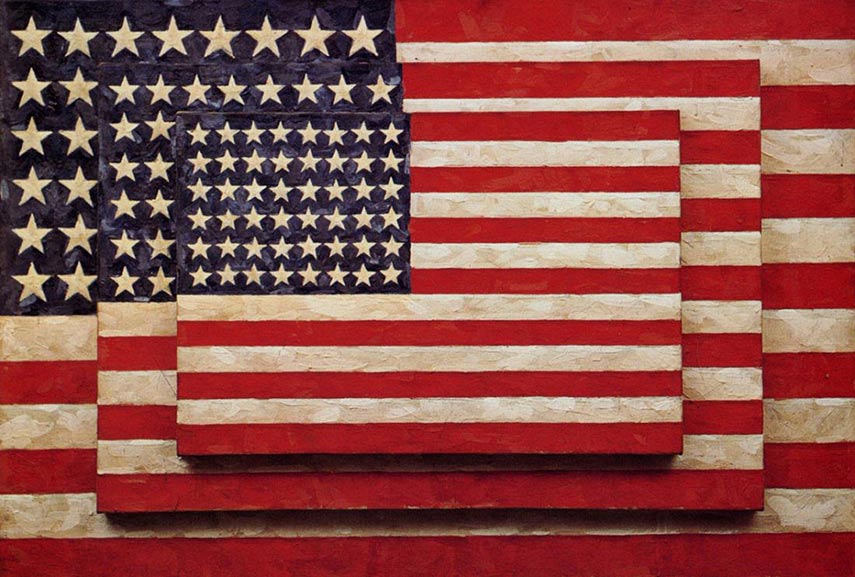
The definition of repetition in art changed throughout the years. Few of the major concerns that arise when 1 speaks about repetition are for sure problems of originality, actuality, and appropriation. This is a major concern for the Postmodernism philosophy and the Dada readymades are marked every bit important images that ridiculed the need of tradition to provide special significant to the production and the selection of materials. Pop artists, minimalists, performance, and conceptual authors, adopted the concept of undermining the authenticity and value. Cribbing in art, based on the re-use and on the repeat of existing images, raises concerns of copyrights since many contemporary artists apply accessible imagery with trivial or no amending to the original. Such subtle changes raise questions of identity, and if the new pieces trivialize the original[5].
Famous Repetition Artists
Over the terminal two millenniums, many artists of both the past and the present take focused on constant depictions of the same subjects and motifs in their work as this repetition is encoded in the very Deoxyribonucleic acid of art creating - do makes perfect. Every bit aboriginal painters and sculptors created the aforementioned pieces over and over over again until they've mastered their skill, this practice was carried over to the times of Renaissance and Bizarre. However, early on avant-garde artists were the first ones that started repeating exactly the aforementioned motifs without emphasizing the goal of getting more proficient at painting, just instead striving for other intentions. Since then, repetition started to exist a concept through which getting better was not the result an artist was going for. This radical conceptual change proved to be an excellent fit with the anti-traditional art forms of the 20th century, with many individuals relying on constant presentations of the aforementioned subjects and motifs to reach the desired goal. Nosotros volition now present you with a list of the near interesting artists that worked or still piece of work inside the conceptual borders of repetition in fine art practice, all of them striving for different results with such creative strategies.
Claude Monet
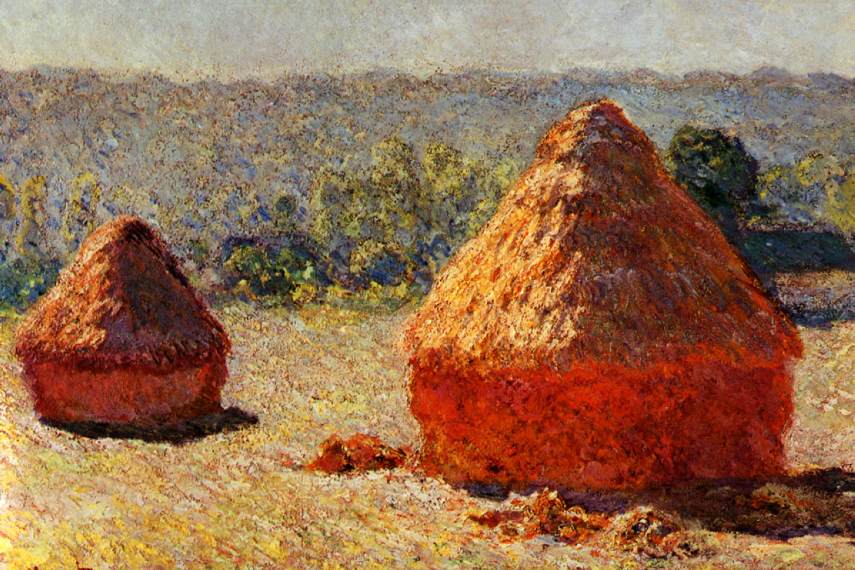
Who better to pinnacle this list than the very human who established the modern concept of repetition without intentions of merely condign more skilled? Claude Monet was a legendary French painter who was a leading figure in the fourth dimension of Impressionism, arguably the beginning advanced movement, although this claim has been often disputed. However, the style impressionists approached their visuals was so radically unlike from archetype art that the entire movement, including Monet, can safely exist placed in the avant-garde category without much trouble. Claude aspired to paint the aforementioned sight over and over again in order to capture the view'southward different state depending on the fourth dimension of the mean solar day in which Monet would pigment them. Through this repetition, he would brand serial of such paintings out of which the nigh acclaimed are depictions of h2o lilies, train stations, grain stacks and cathedrals. Focusing on natural light, Monet did not change the perspectives or equipment, simply the fourth dimension in which he would paint. These pieces are not only of import for the Impressionism phenomenon but are also iconic for their evidential function in presenting an avant-garde mindset of an artist that desired to intermission the bonds with traditional forms.
Piet Mondrian
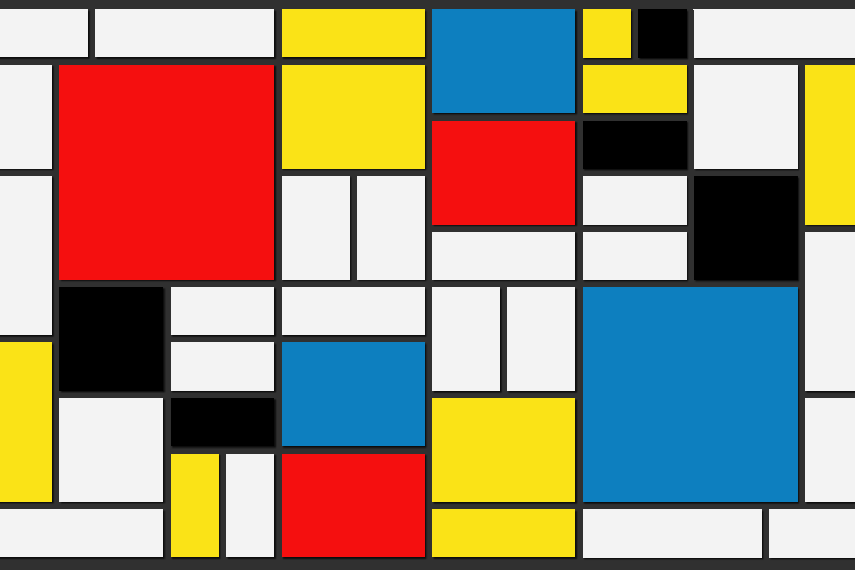
Another avant-garde artist on our list, Piet Mondrian was a painter, theorist and writer who believed that fine art should reverberate the underlying spirituality of nature surrounding the states. In order to somehow brand his aesthetics reflect such an opinion, he simplified the subjects of his paintings down to the most basic elements, revealing the essence of the mystical energy in the residue of forces that govern nature and the universe. Through such strategies, Mondrian eventually established a strict visual vocabulary of squares and lines, presenting subjects in a basic vertical and horizontal fashion. This methodical progression of his artistic style from traditional representation to complete abstraction did not come overnight, just once established, Piet'southward entire output was consisting of repetitive depictions of squares with different colors, separated by strict bold lines. Mondrian's subject in presenting squares is ane of the most famous repetitive concepts in art and the Neoplasticism theory behind them was a key moment of abstraction in painting.
Andy Warhol
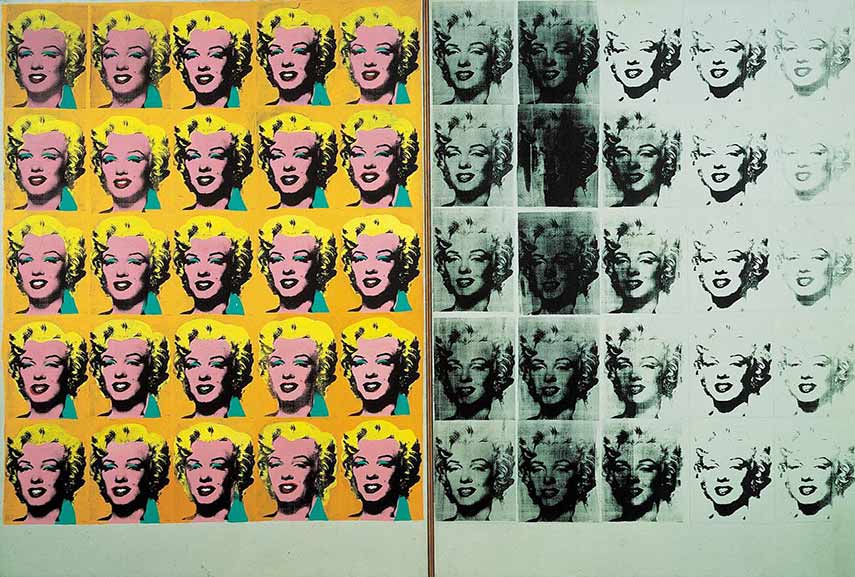
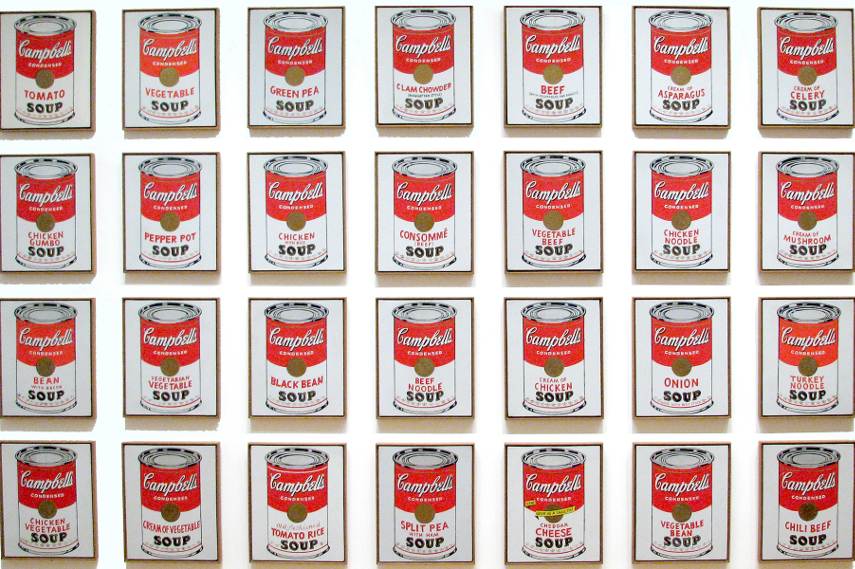
The unofficial king of repetition art, Andy Warhol is the legend of the Popular art phenomenon and i of the virtually commercialized names of the 20th century. Inspired by the imagery of popular culture, Warhol simultaneously celebrated and criticized consumption choices and mass (re)production, finer turning his work into a repetitive whirlwind and establishing the grounds for the nigh successful Post–Earth War II art movement. Working in a wide range of media including printmaking, painting, paw drawing, silk screening, sculpture, photography, music and flick, Warhol became famous and influential for his repetitive images of soup cans, soda bottles, dollar bills and iconic portraits of celebrities similar Marilyn Monroe, Mick Jagger, Elvis Presley, Jimmy Carter, Prince and Elizabeth Taylor. Andy would often insert identical pictures into 1 slice, assembling them with discipline and differencing them just with color. These illustrations, prints, and posters of the same subjects repeated in regular rows are some of the nearly iconic images of the 20th century, credited with re-defining many concepts and setting new standards in contemporary art.
Yayoi Kusama
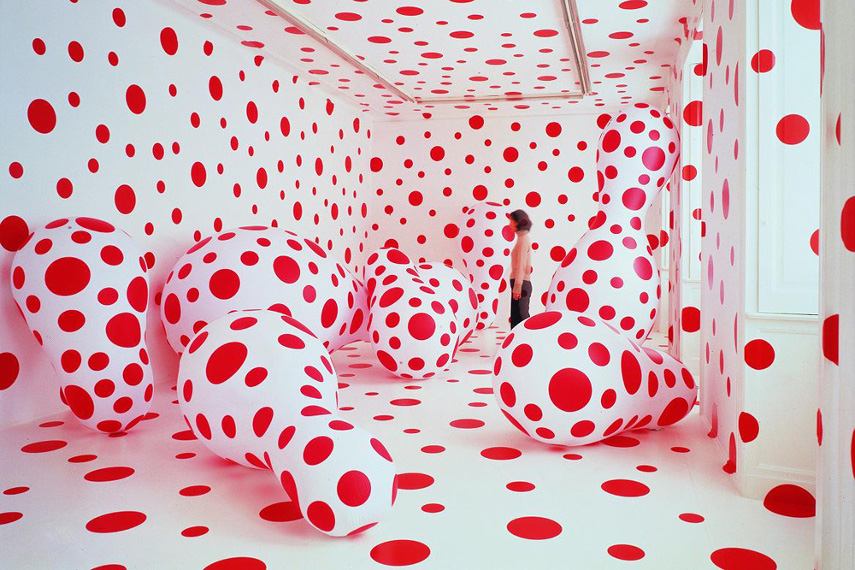
Although the Japanese artist Yayoi Kusama creates in a diverse field that consists of everything from painting to sculpture, every unmarried piece she ever produced has one aforementioned motif all over it - countless dots. These seemingly endless repetitive motifs are the trademark of Yayoi Kusama'south art and eventually became an instant give-abroad that y'all are observing one of her pieces. Through her art of spots, Kusama proved one tin work within mixed concepts of feminism, minimalism, surrealism, Art Brut, pop art and abstruse expressionism without endangering any one manner. Furthermore, the level of repetition of psychedelic colors became the near consistent 1 in the history of modernistic Asian fine art as Yayoi has been active for over sixty years. Due to her unique artistic vocabulary, this provocative advanced creative person from Japan became i of the most prominent figures in her country's contemporary civilization and an first-class display of consistency in modern art.
Yue Minjun
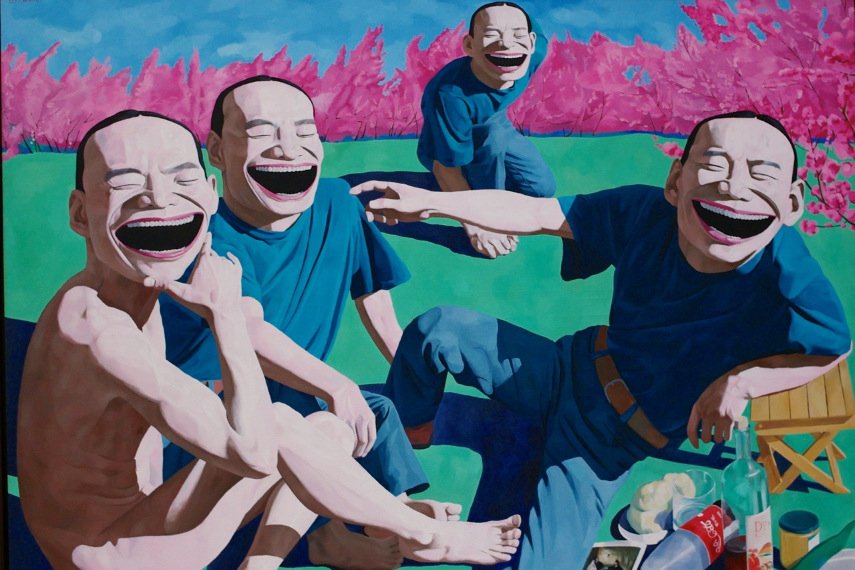
Yue Minjun tin safely exist defined as 1 of the most humoristic artists on this list. This Beijing-based painter and sculptor uses the aforementioned motif in every single piece he creates – his ain face, normally frozen in a state of hysterical laughter. Regardless of what medium Minjun is working in, his cocky-illustrations are arranged in diverse settings, some ironically usual and some far from ordinary, all of them relying on Yue's confront to be the focal betoken. With unique compositions such equally a scene placed amidst a Jurassic menses with two Juis laughing abreast a BMW or a bunch of giggling Minjuns shooting another bunch of Minjuns who also have broad smiles on their faces, it is easy to figure out why this Chinese artist is held in such a high regard and has a wide fanbase. Minjun'south unrivaled sense of humor is truly the strongest aspect of his work, just the fact he places the same motif on every single painting and sculpture he authored is what secured his place on this listing.
Riusuke Fukahori
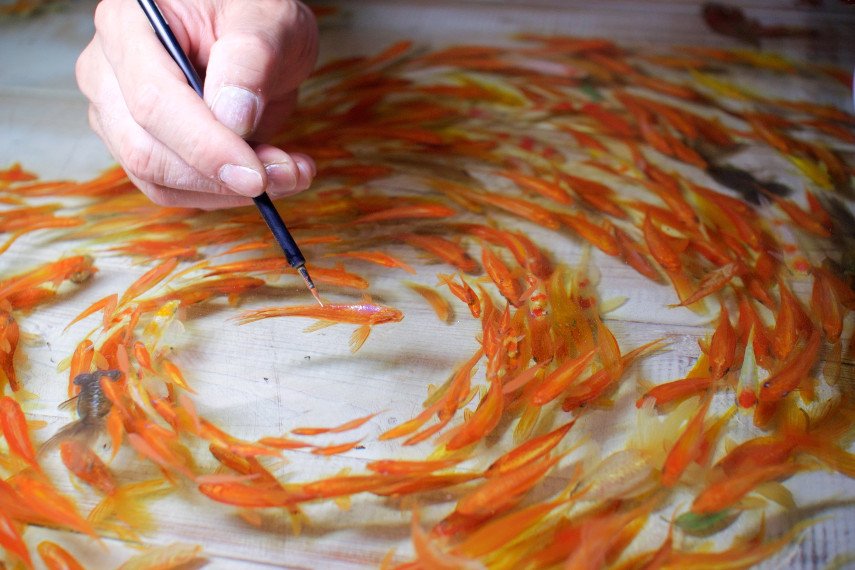
Combining the fields of fine art and magic with his work, Riusuke Fukahori is a Japanese artist all-time known for his 3-dimensional goldfish paintings created by pouring resin. Fukahori brings these adorable creatures to life by portraying them to a degree it is literally impossible to figure out if you are looking at a photograph or a real fauna, let lone a painting of a goldfish. These incredible examples are a result of a career-long defended and consistent depicting of these animals - all Fukahori does is paint goldfishes and that is the be-all and end-all of his work. The cardinal aspect of his uniform work is the fact Riusuke bases his art effectually a repetition of liquid resin pouring and acrylic painting that give the desirable three-dimensional effect. To say these fishes are realistically depicted would be an understatement as the subjects of Fukahori's work have reached an impressive level much better described as an optical illusion. Furthermore, Riusuke claims he never uses photographs of models for his work, claiming that everything he paints comes directly from his retention and imagination.
David Begbie
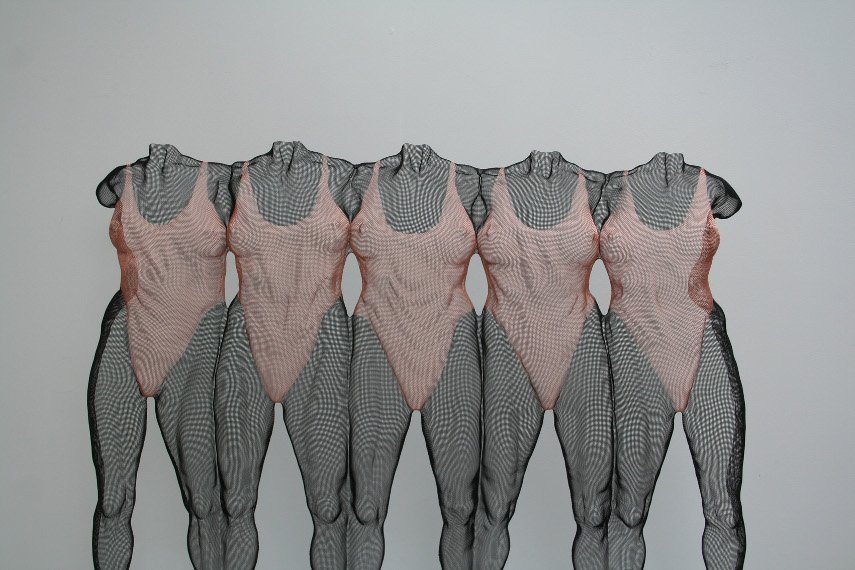
One of the most unusual artists on our list whose style is completely unique and unrivaled, David Begbie is a Scottish sculptor that relies on metal mesh wires in order to depict man figures and facial expressions. Such a technique resulted in numerous similar pieces, most of them presenting us with human torsos which can safely exist described as products of fine sculpting. These powerful, erotic, tactile and intimate pieces are one of a kind and they are only as astonishing every bit they are because Begbie was dedicated enough to devote his entire career to creating the aforementioned subjects through the same method. This is fifty-fifty more impressive when you realize but how difficult working with wire mesh can be, especially when you devote so much attention to details equally David does. In other words, David accomplished what very few artists before him managed to do – reach the sculpted perfection of form. And when put together, his images are clearly a consequent output that is unlike anything you've ever seen.
Pattern and Repetition in Photography
Because patterns and repetition can exist found everywhere effectually u.s.a., photography has a fairly piece of cake job to capture it. "Adequately," considering fifty-fifty though a photographer does not demand to invent 1 from scratch, like painters need to, they should even so have an center for detail and the ability to integrate information technology in their composition the right mode. The soothing feeling of routine that repetition provides for any kind of artwork is best expressed through contrasts, colors and structure in photographs, allowing the image to evoke a sense of unity, coherence and continuity, rhythm, harmony, vividness and overall arrangement [7]. There aren't many photographers who go and intentionally chase patterns and repetitions found in their firsthand environment; rather, information technology is often a hazard encounter with natural or architectural elements that end up in their frame, sometimes even involuntary. Hither, we're talking nigh artists working with nature and abstract epitome-making, although notwithstanding life and aerial photographers are also known for delivering some stunning imagery of repetition in art.
Photographing the Repetitive
Going way back in the history of photography, there are the pioneering images of Eadweard Muybridge, who was the very beginning to create a study of movement. In 1878, he was hired by a racehorse owner to give reply to the debate on whether all four anxiety of a equus caballus were off the ground at the same time while trotting. His serial of images show the aforementioned moving figure over and once again and although it wasn't exactly a repetition, information technology was probably the showtime presentation of such pictures since the photographic camera was invented, and Muybridge did photograph the same items repeatedly. Correspondingly, Bernd and Hilla Becher documented the rural landscape of Frg throughout the 20th century; their photos of gas tanks and winding towers either show the same structure shot from dissimilar angles or group similarly-looking ones together[8].
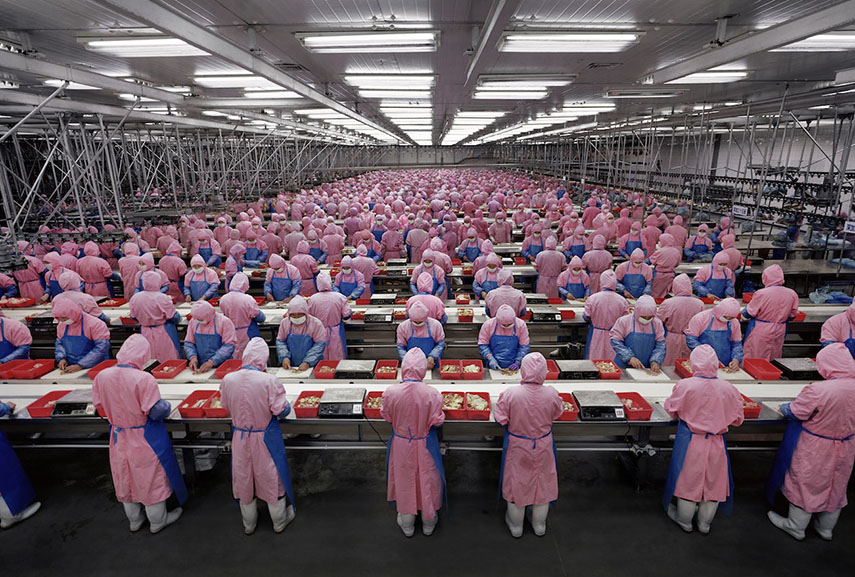
Occasional repetitive elements can also exist found in the production of Gordon Parks, André Kertész and László Moholy-Nagy. While Parks did portraiture and used patterns in group pictures, such as the 1963 Ethel Shariff in Chicago, Kertész and Moholy-Nagy were as well street photographers who often took photos of lines, contrasts and geometric patterns in the urban environment. In the 1930s, Margaret Bourke-White besides donned several shots of workers and radio transmitters, which introduce broken repetition as another form of inventiveness which interrupts the continuity of elements and makes the image even more than dynamic. More images of repetition photography can exist found among the images by Harry Callahan, Bruce Davidson, Ed Ruscha and Ansel Adams, who came across many patterns in nature during his journeys. More recently, nosotros can talk about the creativity of Edward Burtynsky and, at times, Andreas Gursky, who emphasize the notion of massive repetitions.
Tips - How To Create Interesting Patterns and Repetition in Photography
To Infinity and Beyond - Where is Repetition in Art Today?
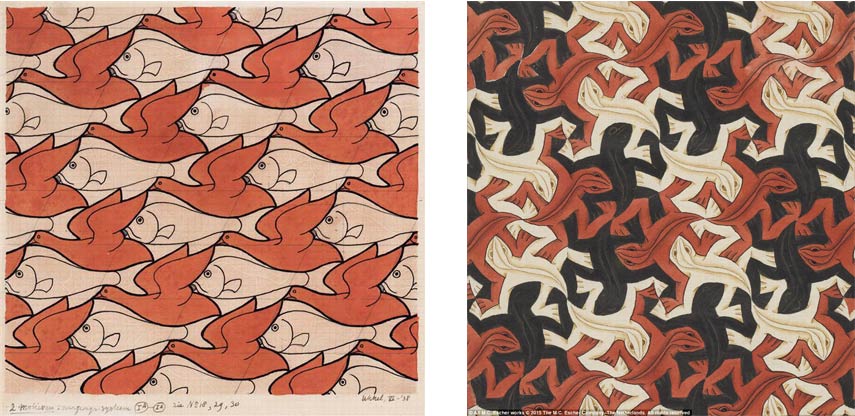
Is repetition in art a matter of the past? It is highly unlikely that information technology will ever be. It is rather simple: its ability to express countless, flawless, captivating imagery is something that will never get out of fashion. Apart from the all-encompassing legacy left by modern and early contemporary artists mentioned in a higher place, many of the creatives working today are interested in achieving perfect, succinct images using repetition, which is why nosotros still run into such a rich number of such images across a variety of media, genres and styles[9]. Think of the circuitous paintings by Chuck Close, who literally creates a bigger picture using smaller, repetitive elements, or Olafur Eliasson'south numerous low-cal installations, come up to mind as well. Inspired past Escher's tessellations, artist Ben Parker uses paper to create mesmerizing artwork, and environmentalist Andy Goldsworthy teams up with nature to form radial sculptures and installations. Repetition was too embraced past the street fine art movement, in item with those working with paste-ups and posters, similar Shepard Fairey. Since the advent of computers and the birth of Digital art, many software have been used to create patterns, although perhaps the best display of repetition in this field is the invention of .gifs. In conclusion, repetition art offers a certain kind of ever-lasting inspiration that appeals to both artists and the audience, and this very fact makes u.s. believe that the concept of reproduction is bound to repeat itself in the future as well.
Written by Silka P, Andrey 5. and Angie Kordic.


Exploring the atmosphere of our present, where the repetition is seen every bit a sign of colorlessness and alienation labor, the author of the book adds a twist and advise the idea that repetition is a moment of bliss and rest. Examining the repeat beyond different disciplines, such as contemporary operation, dance practices, craft, and writing, the On Repetition: Writing, Functioning and Art book offers a new face and originality to the interdisciplinary exploration of repetition inside the contemporary culture - at the same time drawing on psychoanalysis, philosophy, linguistics, folklore, and performance studies.
Sources:
- Anonymous, Repetition, Nook [Baronial 22, 2016]
- Konova, J., Repetition, The Chicago Schoolhouse of Media Theory [August 22, 2016]
- Bearding, What is repetition in fine art?, Reference [August 22, 2016]
- Cooke, A. (2005), Repetition, Robert Henke [August 22, 2016]
- Anonymous (2013), Principle of Repetition, Visual Communication Design [Baronial 22, 2016]
- Soriano, J.G., López Albert, C. (2014), Building Repetition Through History - Motivations And Implications, Mas Context [August 22, 2016]
- Bearding (2011), Repetition in photography, tattahaara [Baronial 23, 2016]
- Horn, C., Introduction to Photography 4: Repetition, Academia [August 23, 2016]
- Anonymous, Repetition, Rhythm and Pattern, flyeschool [August 23, 2016]
Featured image in slider: Damien Hirst – Spot Painting. Image via whatartdoes.wordpress.com; Andre-Kertesz - Photography; Gordon Parks - Ethel Shariff in Chicago, 1963. Image via the-vu.com; Margaret Bourke-White - WOR radio transmitting tower, 1935; Andy Warhol - Dollar Sign; Yayoi Kusama - Kusama with Pumpkin. Image via anothermag.com;
Source: https://www.widewalls.ch/magazine/repetition-in-art-artists-photography
0 Response to "Pearson What Makes Pop Art Fundamentally Different From Abstract Expressionism?"
Post a Comment